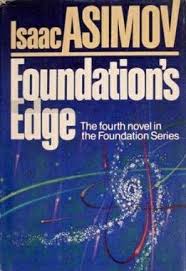
29 years after writing the original trilogy, Isaac Asimov continues Foundation’s generation-spanning space epic with Foundation’s Edge.
The Foundation book series has always been a little strange. Every one of them has felt a bit like an accidental sequel to the last. The first book was a series of short stories, the second book threw the original concept in the trash, and the third book took the ideas from the first two and developed them into a spy thriller.
Combine all that with an author coming into his own and every one of these books feels completely distinct. I’m happy to report that the fourth book in the series continues the pattern of genre-bending ideas and thrilling twists at a galactic scale.
Over a century after book 3, Foundation’s Edge tells the story of Golan Trevize, a council member in the First Foundation, as he investigates the invisible powers pulling The Foundation along the track to becoming a galactic empire. In parallel, Stor Gendibal, a leader of the psychic-led Second Foundation, uncovers a terrifying truth about the Seldon Plan.
For the first half, the story is a political thriller. At each twist and turn, Asimov makes sure to keep the audience fully informed as to what each action did, what it was aiming to do, and how each of the minor characters changes the calculation of the book.
After a series of political maneuvers, speculations, and schemes, Golan Trevize is sent off in search of ‘Gaia’, humanity’s legendary origin planet. At this point, the book’s genre suddenly changes. In a single chapter, we move from political thriller to treasure hunt. Adventure and mystery keep the story moving and the stakes climbing ever upward, ending in a satisfying conclusion.
Asimov’s Writing
Isaac Asimov learned a lot about writing in the nearly thirty-year gap between the third and fourth books. For the first time in the Foundation series, Foundation’s Edge tells a single, continuous story. Multiple POVs, yes, but it begins at the beginning and ends at the end. No century-long time jumps and no being introduced to an entirely new cast of characters halfway through the story. In this book, we have the time to get to know the characters and truly understand their motivations.
For a good bit of the story, I was confident it was setting up a new trilogy. The first half was paced much slower, deeply exploring the political intrigue while reminding the readers of the events of the past three books. By the two-thirds mark, there were a lot of starts without a lot of resolutions. I was pleasantly surprised when the final third of the book jumped into high-gear, delivering a tense and action-packed finale that closed every thread and reached the grand-scale the Foundation series is known for.
The Conclusion
After the first three books, the Foundation series felt like it was over. The goal of galactic empire was centuries away, but all the major factions had reached a balance, and the ending felt inevitable. With this story, Asimov re-contextualized past stories and painted the inevitable conclusion as a defeat rather than a victory, he introduced adventure and mystery to a completely mapped galaxy and layered new complexities on an already complicated universe in a way that breathed new life into the series.
Much like Asimov’s first and third books, Foundation’s Edge is a conclusion. But this time, the story also feels like the beginning of something new.
The following is a spoiler-filled discussion of the original Foundation trilogy.
The first book in the Foundation series is a proof of concept. A series of stories about different groups surviving major crises through economic and societal forces. You see a planet that survives by playing other kingdoms against each other, using religion as a tool of control, and weaponizing trade to collapse enemy kingdoms. But at some point in the process of telling an epic story that spans centuries, that story structure stops working.
Flaws in The Foundation
First, we need to give Asimov some credit. Foundation wasn’t meant to be a book. It was originally a group of short stories in Astounding Science Fiction magazine. You aren’t supposed to bundle them all together and read them as one big thing. But at some point, they did, and in time the flaws in the foundation began to bleed through.
The first and most troubling issues of The Foundation is its constantly changing cast. In the first book alone, there are 4 completely disparate groups of people. This is jarring as a reader. You finally figure out all the names, you know who the people are, what they’re trying to do, and then BAM! The crisis is solved and everyone you knew is gone. One of them might be mentioned in passing in the future, but mostly, these are people who are lost to the forces of history. This sucks. The hardest part of books is starting them, you have to go in blind and start memorizing names. In this book, you have to start it 4 different times.
Then there’s issue 2. I believe this issue is the poison at the heart of the series premise. Nobody in the story has the power to change the future. They have free will, to a degree, but most characters in this story are nothing but pawns in The Great Seldon Plan. One of the stories, called “The Merchant Princes”, introduces us to traders, spies, and warlords. But at the end of the story, the warlords declare war, and then collapse on themselves a year later due to their reliance on Foundation technology. None of the actions of any of the characters had an impact on the course of the story. The vision is clear, a story where the movement of crowds dictates the future is one where a single standout individual doesn’t belong. But you know what, I like stories where someone does something heroic! Where they save the day! Or fail! Either way, they’re trying! In the first Foundation book, Harry Seldon, a character long dead controls the entire story, including its outcome.
The last big issue is predictability. By the fourth Seldon Crisis, you know how it’s going to end. Things are gonna get worse for a while, and then something miraculous happens and suddenly things will work out. As I was reading the second book, I seriously considered putting it down, because it was more of the same. Characters, crisis, solution. Characters, crisis, solution. Who needs a seven book series?
Thankfully, Asimov had spotted the same problems, and at the halfway mark of the second book, Foundations and Empire, he broke the mold and gave us something new.
The Mule
Books 2 and 3. These represent the end of the original Foundation Trilogy. Everything until the halfway mark of book 2 is just like book one. More of the same. Characters, crisis, solution. And I think Asimov knew what he was doing at this point, because he emphasized an almost religious dedication to the Seldon plan among members of the Foundation.
So how do you fix a story where one character created the perfect plan? Simple, you make that plan fail. Let’s meet The Mule. The Mule is mentioned off-hand by various characters during the second crisis of book 2. You get the feeling he might be The Crisis, but at the same time, there’s a lot going on. At the end of the story, the hologram of Harry Seldon appears and talks about how happy he is that The Foundation resolved its Civil War. The trouble is: There was no Civil War. A moment later, The Foundation is conquered.
This is thrilling! Something new is happening, characters are running for their lives, the Seldon Plan is dead. We have stakes again! We have mystery! Who is the Mule? How did he conquer The Foundation? How did the Foundation work in the first place?
The back half of Book 2 gives us a lot of answers, but mostly, it gives us characters worth following. We get Bayta, Toran, and Magnifico, fleeing from The Mule and searching for the legendary Second Foundation. It’s funny to say, but just having one set of characters for a full half of a book feels really nice. You finally get to know their motivations, see them struggle against the world, and in the end, even succeed in stalling The Mule’s quest to conquer the galaxy. It ends on a cliffhanger, but the end of Book 2 is the most fulfilling conclusion we’ve had yet in the series.
The Book with Charm
And that brings us to Book 3. Book 3 represents a big shift in the story. Until now we’ve been telling a story about people, sometimes regular, sometimes heroic, living their lives. But as of the start of Second Foundation, we get superpowers. The Mule is a mutant that controls people’s emotions and loyalty, the second foundation has similar, but weaker abilities. In an epic clash of psychic power, The Mule is stopped in his tracks, but the Seldon Plan is still in tatters.
This is a nitpick; but I don’t love superheroes fighting each other in my Science Fiction. It’s a silly thing, but the word Science is in the title of the genre. If we establish a superpower villain, that’s cool, but let him be beaten by regular folk with specialized technology.
And I think Asimov heard my complaint about superheroes, because right after The Second Foundation saves the day, they become the villains. This is what I wanted from the beginning of the series. There is something about an elite class of people, or even just one Harry Seldon, controlling the course of history that is antithetical to freedom. It feels gross. We as people want the right to screw things up as much as we want. So in a strange twist, the back half of Second Foundation tells the story of a few mind-controlling elites trying to restore The Seldon Plan, and a few regular folk working to unravel it. And somehow, I 100% cheer for the regular folks doing the dumb thing and fighting against the sheer force of history.
Beyond the tension between free-will and ‘what’s good for you’, this is the part of The Foundation series with the best characters. A bold young girl that stows away on a spacecraft, the girl’s father who is both brilliant and extremely stressed, a bumbling uncle that finds himself in a position of enormous status and power. For once it’s not just power politics and societal analysis, it’s got real charm to it!
The end is fun too, lots of betrayals and mistrust. Kind of a bad ending, kind of a stalemate, but it’s conclusive, and when it’s done, it really feels like a cohesive series.
CONCLUSION
So how did he do it? How did Asimov save the series? The Seldon Plan was making things too predictable, so he broke it. And from that breaking, a world of story opened up. Sure, the rest of the series is about trying to follow the plan, but trying is the key word. Success was no longer a guarantee. When a character did something, it either worked or it didn’t. But no matter what, their actions changed the course of the story.
I think the Foundation Series is an education in character free-will. The more free will a character has in the story, the more interesting it is. When the story feels predictable, people’s brains fill in the details and they clock out of the story. The greatest things Asimov did in his story was finally letting it go off the rails.
 Author Logan Sidwell