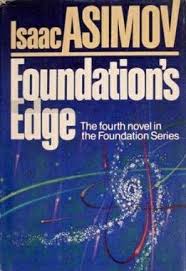
29 years after writing the original trilogy, Isaac Asimov continues Foundation’s generation-spanning space epic with Foundation’s Edge.
The Foundation book series has always been a little strange. Every one of them has felt a bit like an accidental sequel to the last. The first book was a series of short stories, the second book threw the original concept in the trash, and the third book took the ideas from the first two and developed them into a spy thriller.
Combine all that with an author coming into his own and every one of these books feels completely distinct. I’m happy to report that the fourth book in the series continues the pattern of genre-bending ideas and thrilling twists at a galactic scale.
Read my discussion of the first three Foundation books here: How Asimov Saved The Foundation Books
Plot
Over a century after book 3, Foundation’s Edge tells the story of Golan Trevize, a council member in the First Foundation, as he investigates the invisible powers pulling The Foundation along the track to becoming a galactic empire. In parallel, Stor Gendibal, a leader of the psychic-led Second Foundation, uncovers a terrifying truth about the Seldon Plan.
For the first half, the story is a political thriller. At each twist and turn, Asimov makes sure to keep the audience fully informed as to what each action did, what it was aiming to do, and how each of the minor characters changes the calculation of the book.
After a series of political maneuvers, speculations, and schemes, Golan Trevize is sent off in search of ‘Gaia’, humanity’s legendary origin planet. At this point, the book’s genre suddenly changes. In a single chapter, we move from political thriller to treasure hunt. Adventure and mystery keep the story moving and the stakes climbing ever upward, ending in a satisfying conclusion.
Asimov’s Writing
Isaac Asimov learned a lot about writing in the nearly thirty-year gap between the third and fourth books. For the first time in the Foundation series, Foundation’s Edge tells a single, continuous story. Multiple POVs, yes, but it begins at the beginning and ends at the end. No century-long time jumps and no being introduced to an entirely new cast of characters halfway through the story. In this book, we have the time to get to know the characters and truly understand their motivations.
For a good bit of the story, I was confident it was setting up a new trilogy. The first half was paced much slower, deeply exploring the political intrigue while reminding the readers of the events of the past three books. By the two-thirds mark, there were a lot of starts without a lot of resolutions. I was pleasantly surprised when the final third of the book jumped into high-gear, delivering a tense and action-packed finale that closed every thread and reached the grand-scale the Foundation series is known for.
The Conclusion
After the first three books, the Foundation series felt like it was over. The goal of galactic empire was centuries away, but all the major factions had reached a balance, and the ending felt inevitable. With this story, Asimov re-contextualized past stories and painted the inevitable conclusion as a defeat rather than a victory, he introduced adventure and mystery to a completely mapped galaxy and layered new complexities on an already complicated universe in a way that breathed new life into the series.
Much like Asimov’s first and third books, Foundation’s Edge is a conclusion. But this time, the story also feels like the beginning of something new.
 Author Logan Sidwell