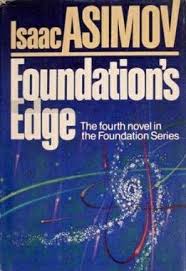
29 years after writing the original trilogy, Isaac Asimov continues Foundation’s generation-spanning space epic with Foundation’s Edge.
The Foundation book series has always been a little strange. Every one of them has felt a bit like an accidental sequel to the last. The first book was a series of short stories, the second book threw the original concept in the trash, and the third book took the ideas from the first two and developed them into a spy thriller.
Combine all that with an author coming into his own and every one of these books feels completely distinct. I’m happy to report that the fourth book in the series continues the pattern of genre-bending ideas and thrilling twists at a galactic scale.
Over a century after book 3, Foundation’s Edge tells the story of Golan Trevize, a council member in the First Foundation, as he investigates the invisible powers pulling The Foundation along the track to becoming a galactic empire. In parallel, Stor Gendibal, a leader of the psychic-led Second Foundation, uncovers a terrifying truth about the Seldon Plan.
For the first half, the story is a political thriller. At each twist and turn, Asimov makes sure to keep the audience fully informed as to what each action did, what it was aiming to do, and how each of the minor characters changes the calculation of the book.
After a series of political maneuvers, speculations, and schemes, Golan Trevize is sent off in search of ‘Gaia’, humanity’s legendary origin planet. At this point, the book’s genre suddenly changes. In a single chapter, we move from political thriller to treasure hunt. Adventure and mystery keep the story moving and the stakes climbing ever upward, ending in a satisfying conclusion.
Asimov’s Writing
Isaac Asimov learned a lot about writing in the nearly thirty-year gap between the third and fourth books. For the first time in the Foundation series, Foundation’s Edge tells a single, continuous story. Multiple POVs, yes, but it begins at the beginning and ends at the end. No century-long time jumps and no being introduced to an entirely new cast of characters halfway through the story. In this book, we have the time to get to know the characters and truly understand their motivations.
For a good bit of the story, I was confident it was setting up a new trilogy. The first half was paced much slower, deeply exploring the political intrigue while reminding the readers of the events of the past three books. By the two-thirds mark, there were a lot of starts without a lot of resolutions. I was pleasantly surprised when the final third of the book jumped into high-gear, delivering a tense and action-packed finale that closed every thread and reached the grand-scale the Foundation series is known for.
The Conclusion
After the first three books, the Foundation series felt like it was over. The goal of galactic empire was centuries away, but all the major factions had reached a balance, and the ending felt inevitable. With this story, Asimov re-contextualized past stories and painted the inevitable conclusion as a defeat rather than a victory, he introduced adventure and mystery to a completely mapped galaxy and layered new complexities on an already complicated universe in a way that breathed new life into the series.
Much like Asimov’s first and third books, Foundation’s Edge is a conclusion. But this time, the story also feels like the beginning of something new.
Readers of my blog know I used to simulate star-trek style spaceships. It was my entry-point to the world of writing, storytelling, theater, and tech all at once. A part of the reason I studied computer science was to make sense of the one part of the simulator I didn’t understand. My first written stories were simulations written to fill a story vacuum. As a flight director, I was lucky enough to not only write the stories, but perform them.
I told hundreds of stories in my five years simulating starships. Mostly I stuck to my biggest hits. Occasionally we’d test a new story and fiddle with it to make things more exciting. But this flight wasn’t like that. It was supposed to be a nice, normal mission. Instead it ended up being my most memorable flight in a half-decade of incredible stories.
Setting the Scene
The nine crew members each donned their uniform, a felt poncho modified with starship colors and branding. It was a birthday party, every kid was in second or third grade. A bit young, but me and my team had dealt with worse.
One side a school, one side a spaceship.
To reach the ship, they needed to pass through the ‘teleporter’, an old photography dark room door, the revolving kind. They’d step in two at a time. I’d remind them not to touch the side lest they be lost to space, then spin the door 180 degrees.
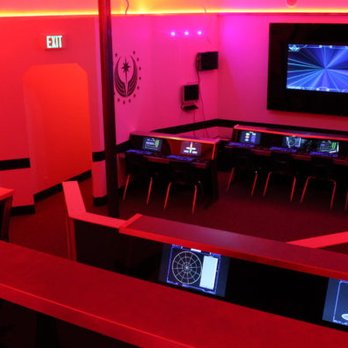
Pitch black for half a second, then the bridge of a starship. Even when you knew the trick, it still felt like magic. The UCS Everest was a large vessel, suited to handle parties of 10-15. There was a main viewscreen at the front and tiered seating at the back. A staff member would ask the arriving crew their job position, then direct them to their seat.
Once everyone was seated, I would teleport in behind them and the epic boarding music would fade away. Safety instructions were always boring, but from the very first second I could tell this crew was different. Eyes wandered, kids whispered. I talk quick, but this crew had no interest in any of it.
When the safety briefing was done, I had a single instruction for my staff. “Get through the training as fast as you can.”
We had a set of junior controls for young crews. Instead of everyone having a distinct job, they were all prompted to do the same activities together and drive the ship as a single unit. For groups younger than 4th grade, it was really the only way to keep them from being overwhelmed. Unfortunately, the most recent windows update had broken the juniors controls, so all we had were the advanced systems.
The Flight
The crew was both overwhelmed and not particularly invested in the story of the mission. They were supposed to fly to an endangered planet and help evacuate the citizens. For crews like this, we like to put a ‘doctor’ on the bridge to help them out. Whenever I came on over the speakers as the main engineer and told them they needed to ‘undock’ or ‘set course’, the doctor secretly made sure the task got done.
In this case, the doctor was basically flying the ship on their own.
Fifteen minutes into the flight, I could tell things weren’t working. I was quietly telling my staff to get ready to ‘board the ship’ as various alien intruders and wacky characters, but while that was being prepared, I needed the story to continue.
The Breakthrough
There was a political situation surrounding the endangered planet. I was on the speakers as a Texan ship captain warning them of the dangers. None of it was clicking, the whole mission was feeling like a bust. Then I said the words that changed the course of the mission. “The mayor of that planet is a crafty fella– he’s got people everywhere. Keep an eye out, you may have a spy on board.”
On the cameras, I could see kids’ heads popping up and glancing around. Their security officer, just eight years old, jumped out of his seat with a toy phaser in hand. There was still conversation being picked up by the microphones, but they weren’t talking about a party. They were talking about the spy.
Not yet realizing what had happened, I had the ‘ship doctor’ get back to the bridge to help them navigate the upcoming asteroids.
The second he teleported in, every kid in the room was out of their seat and yelling at the top of their lungs. They all made different accusations, but there was only one message: The Doctor was a spy.
My first reaction was frustration. Everyone had left their computers, which meant no one was driving the ship, which meant the mission was frozen in place. But these kids had never cared about the mission in the first place. As I watched the doctor get forced into the brig at phaser-point, I saw what I had been looking for since the start. A crew that cared about the mission. Not the space theater or the advance controls or the working together. They only cared about hunting for spies.
If the flight had been a field trip arranged by a school, I would have paused here. The crew would have gone back to their seats and we would have discussed what their priorities needed to be. But this was a birthday party, and when you’re flying a birthday party, it’s best to reserve the lectures for the really bad behavior.
A small brig for 6 suspects
So the mission changed. I ordered a volunteer dressed as a security guard to go up and help the kids interrogate the doctor. But their blind hunger for spies was worse than I thought. The security guard ended up in the brig right next to the doctor.
I was down to two volunteers. The next one I sent up with no costume at all and specifically told the kids that this person was not a part of the story. Just a staff member there to guide their experience. They reluctantly agreed not to stuff her into the brig, but there were plenty of murmurs that she was ‘secretly a spy’ anyways.
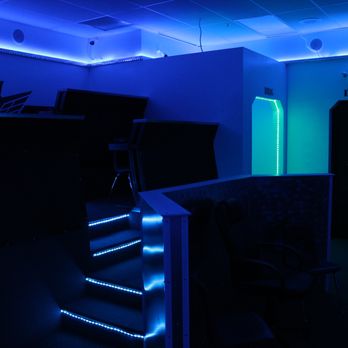
Now that I knew what kind of story we were telling, I knew what kind of tools we should use. We planted a device in a tunnel under their seats and set off the alarms until they found it. We played crazy ‘hacking’ noises over the speakers and flicked the lights from red-alert to green-alert to a bunch of other colors while they flipped switches on a panel. Whenever there was downtime, I didn’t even have to fill in the blanks, the crew would sprint right back to the brig and resume their interrogations of the prisoners.
Then came the masterstroke. An away mission to the lower decks. It’s a funny thing, kids love getting onto the starship, but once they’re on the ship, all they want to do is leave. There was a second starship right across the hall. We redirected that ship’s camera feed to the main view-screen. I told my last volunteer to go in there and stand around.
When the kids saw the footage of a person in a uniform doing nothing, they went wild. Never had they seen a more guilty figure in their lives. The staff member led them on the away mission and they caught the ‘spy’ with ease. They were thrilled for an excuse to use the phasers.
On their way back to the ship, the crew bumped into two unfortunate staff members who were returning from a lunch break. They were dragged to the brig like everyone else.
The Finish
With the end of the mission closing in, I decided it was time for a trial. We gave each student a seat and made them all a part of the jury. One by one we brought out the suspects. I wish I could tell you they were thorough in their questioning. I wish I could say they even listened to what each prospective spy had to say. But they didn’t. It was closer to a witch hunt than any form of judicial process.
At the end, they decided it was the doctor who was the spy. Of course it was, he was the first suspicious figure on the bridge and the only one they all remembered capturing. I told them they were right and that they had successfully completed the mission.
They cheered and ran off with their parents to eat cake. Great reviews all around, although I’m guessing that dying planet from the start of the mission would have a few complaints.
When we finished restoring the bridge from the child hurricane that had ripped through, I sat back and took a breath. One of the other staff members walked over to me with wide eyes. “That was amazing! I’ve never seen a mission like that before. You should write it down and fly it more often!”
I smiled and shook my head. We had improvised 2 and a half hours of nonsense. A playful nothing to distract a bunch of ten-year-olds. It was none of the magic that had drawn me to the program in the first place, and used none of the tools that made the simulator cool. Just one long string of chaos, and we were lucky the kids had liked it.
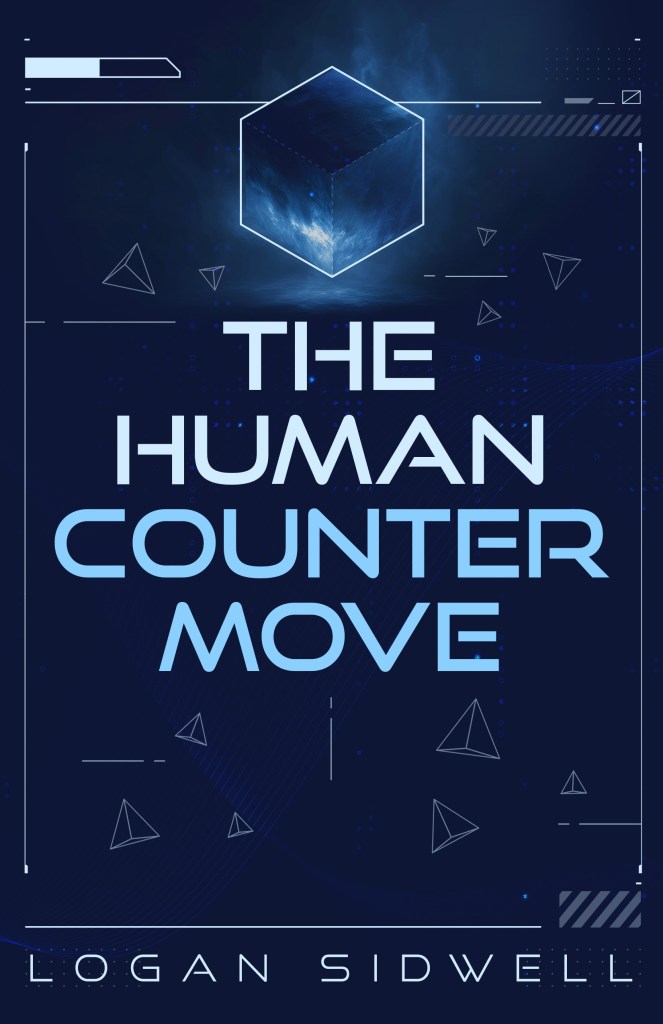
This week I was delighted to receive an in-depth review of my debut novel The Human Countermove from Dan Yocom at Guild Master Gaming. Since release, I’ve come to realize my book’s number one audience is fans of games and strategy gaming. This review represents the viewpoint of an expert in that space, so I’m deeply appreciative they would take the time to consider my book and give so much fantastic feedback. Check out what they have to say!
Through stories we see aspects of ourselves and the world we live in. The Circle shows us a world where social media becomes ubiquitous and inescapable. The Fifth Season quietly highlights the bubbling fury of institutional oppression and racism. Neuromancer blurs the relationship between people and technology. Every time, these dark stories end in tragedy. A mirror that reflects a dark and cruel world where people in power serve themselves and sacrifice others without a second thought.
These stories keep us grounded. They keep us connected to how the world really works.
They’re also a self-fulfilling prophecy. Too many sad stories about an irredeemable world and people start to believe it. In a world with no principles, staying committed to a moral fiber becomes the losing move. We become cynical and jaded. Once a community stops protecting one another and each individual focuses on fending for themselves, it stops being a community.
But it doesn’t have to be that way. A mirror doesn’t have to highlight our worst instincts, it doesn’t have to reflect our darkest selves. It can do the opposite. It can show us our best selves, an aspirational vision of who we wish we were. Stories of idealists like Mr. Smith Goes to Washington, or of a new society like the utopian days of early Star Trek.
We need more aspirational stories.
In 1986, Star Trek: The Voyage Home, transparent aluminum was introduced as a curious futuristic invention. A novelty. But not to the chemists and engineers that watched that movie. Transparent aluminum now exists, a case of life imitating fiction. It’s not the only time this has happened. Mobile phones, tables, and voice controlled computers were all first Star Trek tools before they became our reality.
The opposite is just as true. War of the Worlds told the story of a highly advanced alien invasion involving chemical warfare, lasers, tanks, and aircraft. Fifteen years later, we saw almost all these inventions in WW1. Squid Game told the story of increasingly desperate contestants in a lethal competition, now the competition is a real game show (except for the lethal part).
We underestimate the power of collective thought. A politician achieves their ambitions by convincing enough people something is possible. A stock rises or falls not based on the company’s performance, but its perception. If an expert tells a country they are in decline, it becomes true.
So what happens when the only stories we tell of the future are dark and cynical? Black Mirror stops being a warning and instead becomes a checklist. Every person sees every other person’s action in the worst possible light. Billionaires take notes on dystopian stories and program them into their product. The scientists that grow up on these stories fear the consequences of their inventions.
In 2023, Alexander MacDonald, NASA’s chief economist said about the impact of sci-fi writers. “We don’t go to space because we have the machines. We go to space because we have a culture of people who are inspired to build the machines.”
We need science fiction stories that imagine and inspire, that tell the stories of heroes saving the day and technologies that transform life in the most wonderful of ways. Most importantly, we need sci-fi stories that dream of a bright future.
But this isn’t just a problem with science fiction, it extends into fantasy and thrillers and mystery and every other genre. We keep telling stories about vigilante superheroes in corrupt societies. What about the leaders that shine a light on corruption and fight to make things better? Instead of cynical wheeling and dealing in the west wing, what about an idealist that manages to get a piece of impossible legislation passed because they inspire their peers?
It’s something I’ve been wanting to adjust in my writing. I want to dream of a better world and a better universe. I want to know that the stories I write inspire a materials scientist thirty years from now to invent bendy glass, or bouncy steel, or non-toxic mercury.
We’ve spent a long time critiquing the present. For incremental change, critique is incredibly important. It keeps us moving forward. But it won’t be revolutionary. It won’t reinvent how we live.
The only way for that to happen is for us to change the types of stories we tell ourselves. Fill the world with moral, upstanding heroes by telling stories of moral, upstanding heroes. Advance technology to improve the human experience by telling stories of technology that improves the human experience.
It’s naive. It’s idealistic. But that’s what storytelling is for. For us to one day live in a utopia, we first have to imagine it.
The following post contains spoilers for the novel The Circle by Dave Eggers.
I used to work for a tech company, somewhere over 1000 employees. I did a bit of coding, a bit of problem-solving, but most importantly a whole lot of messaging other people. There were a million different channels for a million different things. Some niche, some broad, but every one of them had new posts each morning.
When I first started, I tried to keep up with everything. It made me a nervous wreck. Then I tried to ignore everything, and I’d miss key announcements. I’ve always disliked those big messaging systems, and I’m glad I’m free of them.
Reading The Circle by Dave Eggers was like being dumped right back into the worst of it.
The book tells the story of Mae Holland, an eager-to-please young woman hired into the biggest social media company in the country, The Circle. She starts her job by constantly monitoring and posting to every little channel in The Circle’s network. The chapters when she’s posting, reading, and responding to surveys stress me out. It highlights early The Circle’s attitude towards information. Any moment not gathering or generating information is a moment wasted.
But it’s not all posts and likes. The story’s true plot is a battle for Mae’s soul.
At work, the executives and the employees make the argument for all the good social media is bringing to the world. No more secrets. No more backroom deals. All the world a friend.
At home, Mae’s parents and ex-boyfriend strive to protect their privacy. They don’t dare put down Mae’s achievements, but there’s a quiet reticence from her family to hop on board the information bandwagon.
But The Circle isn’t about Mae, and the fight for Mae’s soul is allegorical. The true fight is ours.
The Products of The Circle
We see a dozen different products from The Circle over the course of the book. Tiny cameras planted on every street corner, centralized identity systems to tie every post to a single person, complete catalogs of a person’s history. Each product helps build The Circle’s philosophy. Any information that isn’t recorded is information wasted. We even see 1984 style slogans like “All that happens must be known”.
But it comes from a good place. One of The Circle’s employees Francis Garaventa is out there inventing new ideas with the goal of protecting children. The kind of respectable, un-debatable goal that justifies putting chips in kids’ arms.
Later in the book, we see politicians wearing body cameras for their conversations. We see The Circle ask their users all kinds of questions and use those polls to push their political influence forward. The novel asks its readers hard questions. Is it so wrong to want to live in a transparent world? Is it so wrong to want to protect everyone? Aren’t you tired of the secrets and backroom deals of today?
Of course, with each product, we see both sides. All the good it could do, and all the privacy we’d have to surrender.
The Three Wise Men
In the back half of the book, we meet The Three Wise Men. These are the founders of The Circle. One a tech genius, one a product guy, and one a salesman.
Here, the book poses its second debate. If the products of The Circle didn’t send a shiver down your spine. If you find yourself drawn in by the products, happy to surrender a little privacy for a little more safety, Dave Eggers presents the flaw in making such an exchange.
The scene is presented as a meeting of three aquatic animals. A reclusive seahorse, an ever-stretching octopus, and a shark. The Three Wise Men. The meeting ends the way it always had to end. A shark is the only thing left in the tank.
A decade after the whole world joins The Circle, who will control the company? And how long do good intentions last?
Guided Into Their Arms
Mae’s journey into the inner sanctum of The Circle is one filled with tricks and manipulations. As she embraces the philosophy of The Circle. Her relationship with her family weakens with every visit. Her ex-boyfriend’s diatribes in favor of a less connected world feel more out of place with each speech. Mae’s embrace of the “Privacy is Theft” motto enables her to post his heartfelt hand-written letter online, a place where an echo chamber of commenters reinforce her every bias.
Then Mae makes a mistake. One with mild police involvement. The Circle is benevolent, it’s understanding, it helps Mae find freedom through confession of her mistakes.
A friend of mine pointed out The Circles tricks were exactly what a cult does to ensure its members stay with them forever. Cut off family and friends, take away Mae’s identity outside The Circle, let the social network fill her with all the love she’s losing without her family.
With Mae secure in The Circle, the evil plot is revealed. It’s not enough that all Circle users surrender their data. Everyone needs to be a part of it. A friendly invitation to be enforced on every citizen.
Tragedy and Hard Decisions
Major spoilers below.
Mae embraces it all of it, and The Circle’s influence is pushed to its limit, to tragic results. We see the cost of total transparency when one character’s historical ancestry is revealed to be a long line of monsters and criminals. We see the cost of enforced participation when Mae targets her ex-boyfriend to be brought into the fold.
This is the bucket of cold water, the moment of lucidity in Mae’s data-mining fever. She’s given a chance to change course. An opportunity to tear The Circle down before it’s drawn around the entire nation.
And she doesn’t.
Because it’s not really her choice to make. The book isn’t about Mae Holland saving the world from the dangers of social media. It’s about society’s enthusiastic surrender of our freedoms, about our call to lift every rock and shine a light down every alley, disregarding any notion of ‘privacy’.
So when Mae makes the wrong choice at the end of the book, she only does it because it’s what we’ve all been doing. Each time we make a new profile, refuse to delete an old one, dig up an old mistake to tear a person down, and offer a new picture for verification, we move one closer to closing The Circle.
The battle of The Circle is far from over. There have been some real victories for privacy in the last decade. Victories that probably looked impossible when this book was written. But if you want a clear picture of the sides and of what could be at stake, The Circle makes an extremely compelling case.
My debut novel, THE HUMAN COUNTERMOVE is now available for pre-order!
The following is a spoiler-filled discussion of the original Foundation trilogy.
The first book in the Foundation series is a proof of concept. A series of stories about different groups surviving major crises through economic and societal forces. You see a planet that survives by playing other kingdoms against each other, using religion as a tool of control, and weaponizing trade to collapse enemy kingdoms. But at some point in the process of telling an epic story that spans centuries, that story structure stops working.
Flaws in The Foundation
First, we need to give Asimov some credit. Foundation wasn’t meant to be a book. It was originally a group of short stories in Astounding Science Fiction magazine. You aren’t supposed to bundle them all together and read them as one big thing. But at some point, they did, and in time the flaws in the foundation began to bleed through.
The first and most troubling issues of The Foundation is its constantly changing cast. In the first book alone, there are 4 completely disparate groups of people. This is jarring as a reader. You finally figure out all the names, you know who the people are, what they’re trying to do, and then BAM! The crisis is solved and everyone you knew is gone. One of them might be mentioned in passing in the future, but mostly, these are people who are lost to the forces of history. This sucks. The hardest part of books is starting them, you have to go in blind and start memorizing names. In this book, you have to start it 4 different times.
Then there’s issue 2. I believe this issue is the poison at the heart of the series premise. Nobody in the story has the power to change the future. They have free will, to a degree, but most characters in this story are nothing but pawns in The Great Seldon Plan. One of the stories, called “The Merchant Princes”, introduces us to traders, spies, and warlords. But at the end of the story, the warlords declare war, and then collapse on themselves a year later due to their reliance on Foundation technology. None of the actions of any of the characters had an impact on the course of the story. The vision is clear, a story where the movement of crowds dictates the future is one where a single standout individual doesn’t belong. But you know what, I like stories where someone does something heroic! Where they save the day! Or fail! Either way, they’re trying! In the first Foundation book, Harry Seldon, a character long dead controls the entire story, including its outcome.
The last big issue is predictability. By the fourth Seldon Crisis, you know how it’s going to end. Things are gonna get worse for a while, and then something miraculous happens and suddenly things will work out. As I was reading the second book, I seriously considered putting it down, because it was more of the same. Characters, crisis, solution. Characters, crisis, solution. Who needs a seven book series?
Thankfully, Asimov had spotted the same problems, and at the halfway mark of the second book, Foundations and Empire, he broke the mold and gave us something new.
The Mule
Books 2 and 3. These represent the end of the original Foundation Trilogy. Everything until the halfway mark of book 2 is just like book one. More of the same. Characters, crisis, solution. And I think Asimov knew what he was doing at this point, because he emphasized an almost religious dedication to the Seldon plan among members of the Foundation.
So how do you fix a story where one character created the perfect plan? Simple, you make that plan fail. Let’s meet The Mule. The Mule is mentioned off-hand by various characters during the second crisis of book 2. You get the feeling he might be The Crisis, but at the same time, there’s a lot going on. At the end of the story, the hologram of Harry Seldon appears and talks about how happy he is that The Foundation resolved its Civil War. The trouble is: There was no Civil War. A moment later, The Foundation is conquered.
This is thrilling! Something new is happening, characters are running for their lives, the Seldon Plan is dead. We have stakes again! We have mystery! Who is the Mule? How did he conquer The Foundation? How did the Foundation work in the first place?
The back half of Book 2 gives us a lot of answers, but mostly, it gives us characters worth following. We get Bayta, Toran, and Magnifico, fleeing from The Mule and searching for the legendary Second Foundation. It’s funny to say, but just having one set of characters for a full half of a book feels really nice. You finally get to know their motivations, see them struggle against the world, and in the end, even succeed in stalling The Mule’s quest to conquer the galaxy. It ends on a cliffhanger, but the end of Book 2 is the most fulfilling conclusion we’ve had yet in the series.
The Book with Charm
And that brings us to Book 3. Book 3 represents a big shift in the story. Until now we’ve been telling a story about people, sometimes regular, sometimes heroic, living their lives. But as of the start of Second Foundation, we get superpowers. The Mule is a mutant that controls people’s emotions and loyalty, the second foundation has similar, but weaker abilities. In an epic clash of psychic power, The Mule is stopped in his tracks, but the Seldon Plan is still in tatters.
This is a nitpick; but I don’t love superheroes fighting each other in my Science Fiction. It’s a silly thing, but the word Science is in the title of the genre. If we establish a superpower villain, that’s cool, but let him be beaten by regular folk with specialized technology.
And I think Asimov heard my complaint about superheroes, because right after The Second Foundation saves the day, they become the villains. This is what I wanted from the beginning of the series. There is something about an elite class of people, or even just one Harry Seldon, controlling the course of history that is antithetical to freedom. It feels gross. We as people want the right to screw things up as much as we want. So in a strange twist, the back half of Second Foundation tells the story of a few mind-controlling elites trying to restore The Seldon Plan, and a few regular folk working to unravel it. And somehow, I 100% cheer for the regular folks doing the dumb thing and fighting against the sheer force of history.
Beyond the tension between free-will and ‘what’s good for you’, this is the part of The Foundation series with the best characters. A bold young girl that stows away on a spacecraft, the girl’s father who is both brilliant and extremely stressed, a bumbling uncle that finds himself in a position of enormous status and power. For once it’s not just power politics and societal analysis, it’s got real charm to it!
The end is fun too, lots of betrayals and mistrust. Kind of a bad ending, kind of a stalemate, but it’s conclusive, and when it’s done, it really feels like a cohesive series.
CONCLUSION
So how did he do it? How did Asimov save the series? The Seldon Plan was making things too predictable, so he broke it. And from that breaking, a world of story opened up. Sure, the rest of the series is about trying to follow the plan, but trying is the key word. Success was no longer a guarantee. When a character did something, it either worked or it didn’t. But no matter what, their actions changed the course of the story.
I think the Foundation Series is an education in character free-will. The more free will a character has in the story, the more interesting it is. When the story feels predictable, people’s brains fill in the details and they clock out of the story. The greatest things Asimov did in his story was finally letting it go off the rails.
The great thing about a story set on a starship is that every person on board fulfills a different role, they all have their own personalities, skills, cultural background, and for long-voyage vessels, every person on that ship feels disconnected from their home.
I made a mistake when I read this book, I came in with the wrong expectations. At first glance, I believed this was a sci-fi epic, a gritty journey on a run-down starship to an impossible destination. Wrong. What this book really is, is a Cozy Sci-fi. It’s a season of a sit-com set in the stars. So settle down, wrap yourself in a weighted blanket, and enjoy the comforting sounds of the vacuum of space.
Plot
Rosemary Harper, in a bid to escape her past, joins the crew of the Wayfarer on its newest mission: Travel to a planet in a war-torn star system, and build diplomatic ties.
But the book isn’t about the mission, it’s about the characters on that mission. The Long Way to a Small Angry Planet is an ensemble piece. So although we start with Rosemary, she’s just one of many characters. Everyone on board eventually gets their time in the sun.
The flight takes more than a year, and across that extended journey, we take every opportunity we can to stop by a planet, meet some aliens, and have some fun. It really feels like a season of television. Each stop represents an episode of the tv show, conflicts are created, explored, and resolved inside that chapter. Sometimes there are lasting effects that extend to the rest of the book, other times they’re an opportunity for our characters to redefine their relationships with one another and understand themselves more.
All this adds up to a relaxing journey, the story is set to impulse speed and we’re taking the scenic route. The danger in your average chapter is gonna be lower. But emotionally, things are elevated.
Characters
Characters are the bread and butter of this book. Most everyone on-board is an alien or a robot or something else kinda strange. We have Rosemary, a human. Sizzix, the reptilian pilot, Dr. Chef the last of their kind, Lovey the AI with a heart of gold, Ohan the isolationist navigator, and a couple more humans. Together they form a classic sitcom cast with regular culture clashing, personality conflict, and comedic quirks.
I’m not going to go into too much detail on the individual plotlines. All I’ll say is that this book achieves a really good chemistry between its characters. It doesn’t take the world too lightly, and it doesn’t take things too seriously either. The differences in culture, anatomy, personality, and background, all really add to the ‘found-family’ feel of the book.
World building
This book’s world is mostly your standard sci-fi affair. I’d say it leans more in the safer, cleaner direction of star trek than in the rough-shod universes of Star Wars or Firefly. Which lends itself to imagining every scene on a bright, multicam set. There’s a big focus on the friction between human and alien cultures. This book doesn’t lean into the idealistic, non-interventionist enlightenment direction of Star Trek. The crew of this ship are very comfortable sharing their opinions on other cultures, and even openly disagreeing with their fellow crew members.
From time to time, a decision one of the characters made rubbed me the wrong way morally. But this is a book about flawed people finding a home, it shouldn’t be a surprise that people make mistakes.
Conclusion
The book’s big landing is at the end. I won’t spoil it here, but there’s a reason season finales are the most memorable parts of tv shows. You spend the whole book getting to know the characters, building an understanding of their relationships, and growing to care for them. So when conflict forces those relationships to change, it hits hard.
Like any good sitcom, this book is only the first season. A strong start with a great cast and a long way to go.
If you’re looking for a different brand of sci-fi, if you want to travel through space, but feel the right way to do it is with a fireplace and a cup of tea, consider tuning in and seeing what it has to offer.

 Author Logan Sidwell