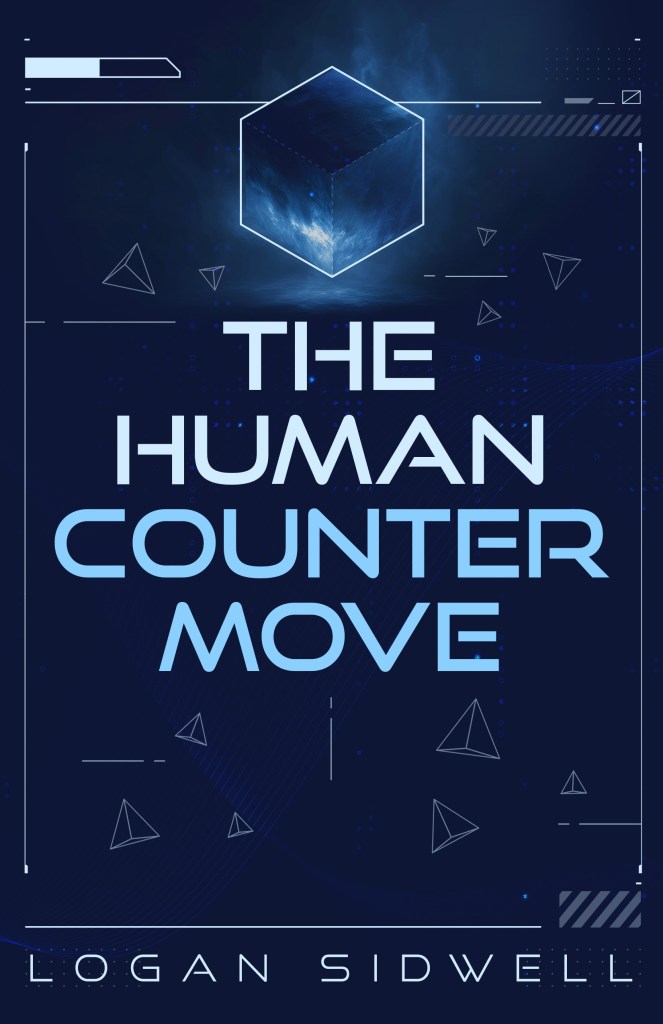
What a month! On September 1st I became a novelist. Now we’re 40 days in and I’ve been incredibly pleased with how the book has been performing. Reviews have been great, interest has really been there, and a lot of people in my life I never expected to read The Human Countermovereached out to me after they finished it to express how much they enjoyed it.
Before release, I spoke to a bunch of self-published authors about a realistic sales goal for a year. 40 days in and I’m nearly three-quarters of the way to that goal. I even had to buy a second round of books the other day! All those Farmer’s Markets really added up, and being able to sell some of the anthologies I’ve contributed to was a great way to expand my product line and donate to my local writing chapter. Instead of one book, I’ve been selling five, everything listed on my Published Works page.
If you’re interested in a signed copy of The Human Countermove, I’ll be at the Utah Reader’s Fest on Saturday. Come by and help my debut novel hit its one year goal before the 50 day marker!
Project APHELION
My next project, codenamed APHELION, is nearly ready! I’m closing in on the end of the second draft, at which point I’ll be querying the book out to agents and getting feedback from beta readers. The book is a hard-science take on portal fantasy and an unpredictable road from beginning to end. I think fans of The Human Countermove will really enjoy how this one turns out. But for now we gotta keep the details scarce.
Editing APHELION has been so much easier than editing the second draft of The Human Countermove. Two and half years have really developed writing skill, and this time around I was able to make good choices right from the start. Most of my work on APHELION’s second draft is minor adjustments and expansions to the setting. The first draft ended at about 87k words, now it’s up to 92k and I’m only halfway there. If you’re interested in my progress, the chapter-by-chapter checklist is tracked on my Current Projects page.
Project PRINTHEAD
With one book published and the next one about to query, my third book is officially in the pipeline! It’s one I don’t dare share any of the details on yet, only that it’ll be a back-stabbing, twist-filled, madhouse of a story. The initial outline is written and as the second draft of APHELION wraps up, I’ll be working through outline #2. Lots of characters in this one, so it’s very important I know where I’m going from the beginning.
Wrapping Up
Thank you all for supporting my book, it has meant the world to see real copies go out into the wild and reviews come back on Amazon. More reviews of my book are in the pipeline for the next few months, and I may even be making a few appearances at some conventions as both a panelist and a vendor. Stick with me, I have a lot more planned for the future!
I wrote a book about a strategy game grandmaster challenging the AI Minds of his society for the fate of the future. It’s got politics, subterfuge, high-minded strategy, and danger. But I think at the heart of it all is a story about connection. A romance. Which is odd, because I don’t write romance.
Spoilers ahead.
A friend of mine pointed this out to me while they were reading my book. In the first chapter, you’re introduced to my main character, Zouk Solinsen, an isolated guy in the back half of his career navigating a cold and disconnected world. We’re then introduced to a young woman named Jamie. A rival in the strategy gaming space, and his opponent in the first round. They’re about the same age, opposite genders, and their conversation has a light, almost flirty back-and-forth before the game.
But it’s a red herring.
The target of this book’s romance isn’t Jamie. One of the romances isn’t even human.
Every good story has a certain element of romance. Whether it’s a pair of characters who hate each other and eventually learn to understand each other, or a collection of disjointed and quirky individuals finding the joy of becoming a cohesive group, what makes a romance is the journey from ambivalence and hatred to appreciation and love. Oftentimes, you don’t even need the kissy-kissy.
There are two ‘romances’ in The Human Countermove. The first is conventional. A small, personal story about Zouk and his wife Kira, whose relationship is on the rocks. Zouk is an outgoing person with a strong skill for communication, while Kira prefers her privacy. For her, a nice day is one spent in her office running data analytics and drinking hot cocoa.
In the time since they got married, life got complicated. Zouk had his career ups and downs, while Kira built quiet, steady work in the government. Zouk wants Kira to change, he wants her to love crowds and events and to be with him for all of it. She tries her best, but it’s not who she is.
But when he needs her, she’s there. Not usually with a well-placed word, but with her most sincere self. When Zouk is trying to make sense of a broken political system, she’s willing to put in weeks of work to help him. And she seems to relish every minute of it.
It’s all this that reminds Zouk why he fell in love with her. He remembers her passion, her care, the way she’s fought to stay in love with him. It’s a Him problem. He’s been asking her to change, when he’s the one that needs to start reaching out. He meets her where she is, accepts her for who she is, and is able to start loving again. They’re able to be that supportive, loving couple they had been chasing from the start.
But there’s a second romance in this story. One at a much larger scale.
A romance between Zouk Solinsen and The Minds.
Zouk is playing a series of strategy games in order to join The Minds’ council. Impossible games that take everything he has in order to win. But winning doesn’t suddenly put Zouk into power, it puts him in a partnership. A shared power structure with The Minds. And anyone forming a partnership knows the only way to make things in a partnership work is to ‘love’ the other party.
There’s an on-again, off-again relationship between Zouk and The Minds throughout the book. Near the beginning, The Mind of Communications and Influence is casual with Zouk. They’re fast friends and get along better than you’d think. The possibility of Zouk winning all the games becomes real. Folks listen when he speaks. The general consensus seems to be that he will be the fourth member of the council.
Then the hard times come. Zouk breaks ties to an organization when he discovers their plot to overthrow the government. And the break-up isn’t easy. A controversial game, a mutiny in the military, riots, and a frame job implicate Zouk in everything.
There’s nothing less romantic than a deposition. One of his wins is thrown out and The Mind of Strategy and Warfare ends his hopes of joining the council on a painful defeat. Whatever partnership The Minds were considering is dead.
If this were a traditional sci-fi dystopian story, this is the part where Zouk leads a resistance and burns it all down. But I wrote a romance. And in a romance, the protagonist doesn’t give up.
Zouk and Kira’s rekindled relationship is a lesson in accepting people as they are. A lesson that leads to a realization. The world talks to The Minds in the same way they talk to politicians. High-minded intellectualism, hopes and ideals, persuasion. But that’s not how The Minds think, that’s not who they are. They’re more like Kira. Evaluating good and bad ideas through raw numbers.
Society has been pushed to their limit. Every aspect is measured and maximized. But by seeing the world through The Minds’ eyes, Zouk and Kira uncover the fatal flaw, the mistake in the calculations, the first fix to a better world. Zouk knows his chance to join the council is dead. But he makes his case anyway. He makes it because he wants a better world, because he thinks The Minds help get them there.
And that act of good will and understanding changes everything.
This is why I say this book is a romance. It’s not traditional, but it hits all the beats. The meet-cute, the impossible relationship, the break-up, and at last the heartfelt reunion. A story whose roots are built in love and empathy rather than rage and destruction. I had no idea I was doing it when I wrote it, and only realized what I had made when it was out in the wild.
Maybe this is just what happens to stories that set out with a theme of connection and understanding. You go in planning on making a sci-fi thriller and end with an AI and a human holding hands in the rain.
The Human Countermove is available for purchase on Amazon!
Board games are usually designed to be played by a group of people. The mechanics are built so that each person has high agency over their own moves and can pursue their own strategy to win. When someone takes ten minutes to make a move, it’s because the player has so many considerations, there’s a real need to think.
If a person can barely track their own moves in a game, how could a reader track an entire game inside a book?
Despite being well aware of the challenges, I put a board game in my first book. In fact, I built the story around it.
LINE. Leadership in Near Emulation. I designed it from scratch. I was able to design a game that was compelling to read about and one that was fun to watch. From the moment I started, I gave myself one important instruction: Keep it simple.
If I ask a reader to track a hand of cards, or all the powerups affecting one of my protagonist’s heroes, I’ll lose them. The only people who understand all the subtleties of a game of Settlers of Catan are the people who played it, and even then, no one knows the entire story. Too many mechanics, too many unknowns, too many surprises. For a reader, an environment like this is hard to track and it doesn’t feel fair to the protagonist.
In LINE, there are only two pieces. Squadrons and walls. The squadrons move from tile to tile and fire on the enemy, while the walls do exactly what walls always do. Simple. At a glance, a casual viewer can glean the entire status of the game. “The enemy army flooded across the map”, or “Every squadron was hunkered down, hiding inside the base and waiting for the ambush.”
Like any good action scene, I avoided over-choreographing the movements on the board. We don’t need to know every intricate detail, we just need to get a feel for the moment, and the challenges facing the protagonist.
On a real board, an attack would translate to a bunch of dice being rolled or a computer running dozens of Random Number rolls. But a reader doesn’t need to know any of that, they just need to know the outcome and what it means for our hero. “The enemy’s walls crumbled under weapons fire. Finally, our battle of attrition was coming to an end.”
As in most board games, some turns completely transform the game, or even hand the victory to one player or the other. But other turns are quiet, an incremental step forward, a plodding move building up to the battle’s climax. When turns like this arise, I use the timeskip. Just like we don’t need to see every piece, we don’t need to see every moment. What I’m really giving the reader isn’t the livestream of the game, it’s a recap with live commentary from the protagonist. All the exciting bits, all the cerebral moments, none of the fluff.
“On Turn 8, a few walls repelled enemy aggression. By turn 24, I had completed ‘The Fallen Star” and set to work preparing an attack.”
But what really defines competition isn’t what happens on the board, it’s who our protagonist is facing. The adversary.
A board game in a book can be exciting on its own. But after a game or two, it gets stale. The audience has seen everything the mechanics have to offer. What really makes a game, or any sport exciting, is the human element.
Every player has their own flavor, their own approach to playing that gives the game a fresh feel. That feeling is informed by the player’s motivations, their intent, and their background. From the way the opponent moves a piece, we can derive how much experience they have with the game. From the way they rock in their chair, we can sense mental distress. It’s these reactions that help us contextualize the game’s importance without having to say it out loud.
Even the protagonist shows these attributes. When they make a mistake, sometimes it’s a ‘clench your fists’ moment, and sometimes it’s a ‘rip your hair out and scold yourself for throwing everything away’ blunder. Since we’re in their head, we know the reason behind their reaction. The whole book has been building to a single game, and now it’s all over because our hero got distracted by a bird for half a second.
But not everything in the story can be a board game. The game may be the most important thing in the protagonist’s life, they still need a reason to play it. The more drama around the game, the better. The harder the opponent, the better.
For my book, I chose the hardest opponents possible. AI Minds. With each game, it’s not just a difficult match, it’s an impossible one. In games like this, the buildup is as exciting as the game. How can Zouk win? What strategy could he possibly use to beat something that plays more games in a week than he does in a lifetime?
The prep matters. It’s like scaling a mountain. If someone casually scales the whole thing on the first try, how difficult was it in the first place? But if we see that person map out their entire approach, do practice runs, and scrape grass from the cracks. We get a much better understanding of the difficulty at hand. If the climber has been practicing jumping from one rock to the other for months, we’ll be thinking about that challenge the whole way up the wall.
After writing a couple LINE games into my story, I still felt the stakes could be bigger. If these games really are determining the future of Ion, they should be played in a stadium. Even better, they should be played with real people on the field. Every game matters to the protagonist, but a few field games are a great way to turn the dial all the way to MAX.
Zouk’s coach helps him work on strategy, finding the right approach and memorizing hundreds of moves. But more importantly, building the game up in the reader’s head. When Zouk thinks he’s found a blindspot in The Mind of Strategy and Warfare’s Algorithm, he spends the entire game getting his units into that blindspot. The tension builds. We may not know all the little nuances of Zouk’s play, we may be skipping five or six turns ahead at a time, but we know what’s coming. We know everything depends on one moment. Will War notice their blindspot, or will Zouk pull off a historic victory?
The Human Countermove is now available for purchase!
I didn’t realize it when I was writing it, but my sci-fi novel is a sports book. There’s a bunch of politics and AI to keep things interesting. But narratively, the book is closer to Moneyball than it is to Star Trek. It’s a funny realization, but an important one. The characters in a story should feel authentic, pieces of them should be drawn from real life, from the emotions and nuances of competition.
In the last few years, I’ve been a casual viewer of a lot of Chess content. Game recaps, lectures, tournaments, all the popular stuff. Along the way, I found a few players and personalities that drew my attention and inspired me to write.
Here are a few of the most significant.
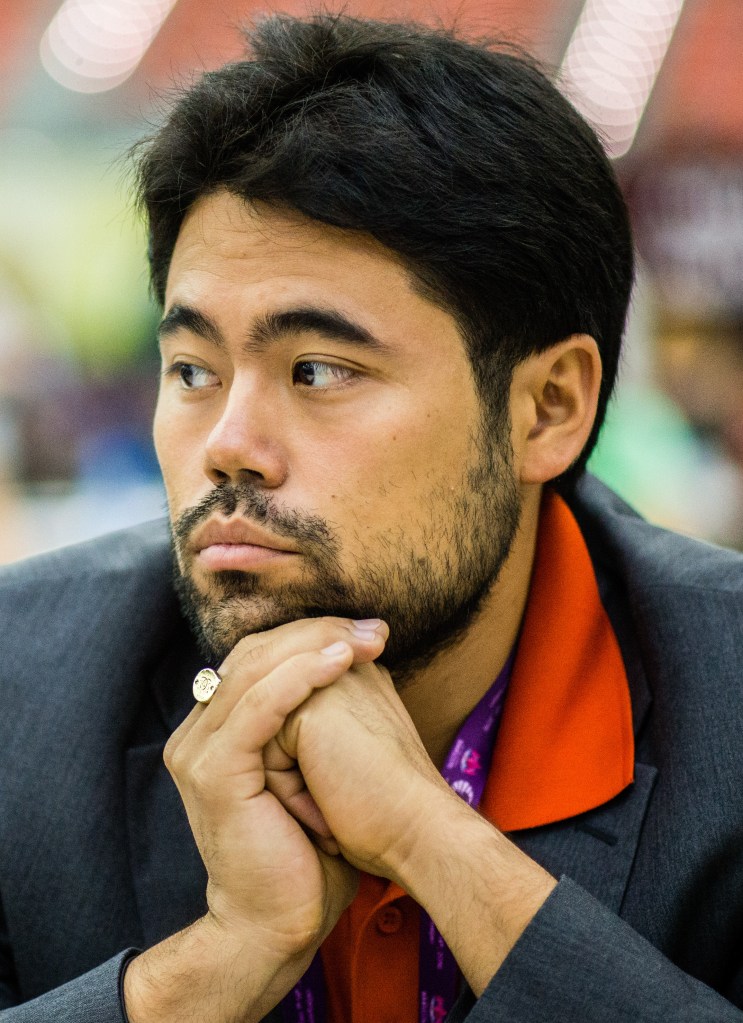
Hikaru Nakamura
A story of achievement is great. A person from one particular background rising above their peers and climbing all to the peak of performance is cool, but it usually doesn’t inspire me. I think it’s because it feels inevitable. If we create a competition with 250 players, somebody’s gotta be the best, right?
For me, the story that draws me in isn’t one of instant success, it’s the story of failure, and the strength to rise again.
In 2015, Hikaru Nakamura was the second best player in Chess. In 2019, he had dropped down to 21st. It may seem small, but that gap was enormous and the product of 3 years of decline.
It’s a mental game. Getting so close to the top, it’s easy to coast. A person can lose their motivation, their drive for competing. Life gets complicated, new priorities arise, old priorities sink. You can even forget why you started in the first place. After 3 years of decline, it can feel inevitable, like the natural lifespan of a career coming to an end. Why bother getting back into shape when the game is already over?
But Hikaru Nakamura didn’t give up. He started streaming. He built a better relationship with the game, and eventually, he found a new reason to compete.
Today, Hikaru Nakamura is back at #2, and his chances of winning the Candidates Tournament are higher than they ever were a decade ago.
I think I find a comeback story so inspiring for two reasons. One, they’re rare. Two, they teach us life doesn’t always turn out the same way for everyone. We can turn things around, rewrite our fate, outperform even our own preconceptions.
In my novel:
Zouk Solinsen is a washed-up strategy game grandmaster. He forgot what made him love the game, he got caught up in other things, teaching students and paying the bills, and he lost his self confidence.
But unique times and unique challenges give Zouk a second chance. A chance to love the game again, a chance to sharpen his strengths and become better than ever. There’s nothing better than a comeback story.
Yasser Seirawan and Garry Kasparov
Back when I was studying chess (I’m not very good), I looked up a lot of lectures on Youtube. My favorites are from Yasser Seirawan. The man approaches teaching with a childlike wonder for the game, an excitement to share his knowledge with anyone who wants to learn.
Yasser Seirawan has been an extraordinary player in the chess scene for 30 years. He was the second for Victor Korchnoi in 1981, meaning he was the chief advisor for the challenger for the world champion title, and all of that before Garry Kasparov was even on the scene.
He’s a player that has faced generations of players. He has seen the absolute best that Chess has to offer and shares it with his students. When he describes how the game transformed with the advent of computers, it isn’t theory, he witnessed it. What better mentor could there be?
And then there’s Garry Kasparov.
In my previous post I discussed at length the significance of Kasparov vs Deep Blue in inspiring my story, now I want to briefly discuss another of the man’s aspects. Politics.
In 1984, just after Kasparov had won two consecutive games against the world champion, FIDE abruptly ended the match, citing ‘player health’. They cheated Garry Kasparov out of a world championship title, and he didn’t take it lying down. The thing is, Kasparov defeating Karpov wasn’t just about Chess. It was about the future of the Soviet Union, and the game was being watched by the whole world.
Since then, the man has led protests, been arrested, and even been forced out of Russia. Every day he shows the boldness and courage most of us wish we had.
In my novel:
Yolniv is Zouk’s mentor. In the face of nearly unbeatable opponents, his decades of experience as both a player and teacher help Zouk discover the right strategies and refine them to a point. He never fears sharing his mind, and as the plot heats up, ancient history comes back to bite him.
Danny Rensch
For a post about famous chess players, Danny Rensch might be a surprise. He’s an International Masters player, sure, but he’s primarily known as the Chief Chess Officer at Chess.com.
And there’s a very particular reason he’s on my list.
Danny Rensch dances on a very thin tight-wire. Every day, the man is both the face of his company, and a key decision maker behind the scenes.
To some extent, all the biggest leaders today have to walk this tight-wire. They show confidence at the investor meetings, then go to their offices and make the hard choices. It’s a funny duality, but I find it more pronounced in Danny Rensch.
When Chess.com hosts a major tournament, he’s there. Casting games, plugging products, hosting the livestream. He’s an entertainer for hours on end. Most entertainers spend their whole career developing the skill to keep people engaged, Danny only gets to do that for half the time.
For the other half, he has to deal with the ugly side of the business. When there’s a controversy in the chess scene, he’s in the room deciding how to handle it. When there’s a clash between two players, he’s mediating the reconciliation. When a tournament needs bigger names and better sponsors, it’s all on him.
He plays both entertainer and decisionmaker. He’s done it for years, and it’s really extraordinary to watch.
In My Book:
The Mind of Communication and Influence (AKA Influence), is the voice of the Minds to the general population. Day to day, Influence is a news man, a face on tv reporting to the people of Iom. But he’s also one of the three Minds. The weight of the executive rests on his shoulders. It’s easy to get the wrong impression of Influence. Either he seems shallow and entertaining, or duplicitous in the separation between his speech and his action. But there’s more than meets the eye to Influence.
Final Thoughts
There are plenty more characters in my novel, some undeniably inspired by other chess players and competitors more broadly. A Magnus Carlsen-based is definitely hiding in my book somewhere. Anna Cramling might be too.
With competition comes real people. Success for one means failure for another. Everyone who competes does so sincerely, and it’s rare to get that kind of truth from a person these days. Virtues and flaws are put on display because anything less than giving it your all dooms you to defeat, and all that honesty makes for a great character.
The Human Countermove is now available for purchase! Click the image to be taken to the amazon page.
Postscript: Although certain figures in The Human Countermove draw inspiration from real chess players, the story is a work of fiction. The characters and their choices are not reflections or critiques of any actual individuals.
After three years my debut novel is now available to purchase on Amazon! It’s a cerebral, near-future sci-fi built from my love of strategy games like Chess. In the next few days I will be releasing a post discussing all the different strategies and games I built my book from, but today it’s all about the celebration!
Thank you to all my readers, my family, and my friends. Becoming a novelist took a lot longer than I expected, but I’ve enjoyed every little project along the way. The terrible practice novel, the staged reading of my play, the years developing ed-tech stories for students, each project was a step on my journey here.
Don’t worry, I have no intention of stopping. My next project (Project APHELION) is already about 10% of the way through its second draft, so hopefully it won’t be too long before we’re back here again with another exciting story.
As I schedule appearances at book signings, farmer’s markets, and reader events, I will post them here.
In a nation ruled by AI Minds, productivity is everything—even play.
Once a legend in the world of strategy games, Zouk Solinsen is now just another burnout in a society obsessed with efficiency. But when the Minds announce a high-stakes tournament—with a seat on the ruling council as the prize—Zouk is drawn back into the fray, determined to reshape the future.
With help from the enigmatic Torrez Institute, Zouk racks up early victories against the Minds. But when Maya Torrez reveals the cost of her support—a violent coup against the Minds—he rejects it and strikes out alone.
Now, with no allies, dwindling resources, and a nation on the brink, Zouk faces the biggest game of his life—and a final, impossible choice: reform the system from within, or burn it all down.
The following post contains spoilers for the novel The Circle by Dave Eggers.
I used to work for a tech company, somewhere over 1000 employees. I did a bit of coding, a bit of problem-solving, but most importantly a whole lot of messaging other people. There were a million different channels for a million different things. Some niche, some broad, but every one of them had new posts each morning.
When I first started, I tried to keep up with everything. It made me a nervous wreck. Then I tried to ignore everything, and I’d miss key announcements. I’ve always disliked those big messaging systems, and I’m glad I’m free of them.
Reading The Circle by Dave Eggers was like being dumped right back into the worst of it.
The book tells the story of Mae Holland, an eager-to-please young woman hired into the biggest social media company in the country, The Circle. She starts her job by constantly monitoring and posting to every little channel in The Circle’s network. The chapters when she’s posting, reading, and responding to surveys stress me out. It highlights early The Circle’s attitude towards information. Any moment not gathering or generating information is a moment wasted.
But it’s not all posts and likes. The story’s true plot is a battle for Mae’s soul.
At work, the executives and the employees make the argument for all the good social media is bringing to the world. No more secrets. No more backroom deals. All the world a friend.
At home, Mae’s parents and ex-boyfriend strive to protect their privacy. They don’t dare put down Mae’s achievements, but there’s a quiet reticence from her family to hop on board the information bandwagon.
But The Circle isn’t about Mae, and the fight for Mae’s soul is allegorical. The true fight is ours.
The Products of The Circle
We see a dozen different products from The Circle over the course of the book. Tiny cameras planted on every street corner, centralized identity systems to tie every post to a single person, complete catalogs of a person’s history. Each product helps build The Circle’s philosophy. Any information that isn’t recorded is information wasted. We even see 1984 style slogans like “All that happens must be known”.
But it comes from a good place. One of The Circle’s employees Francis Garaventa is out there inventing new ideas with the goal of protecting children. The kind of respectable, un-debatable goal that justifies putting chips in kids’ arms.
Later in the book, we see politicians wearing body cameras for their conversations. We see The Circle ask their users all kinds of questions and use those polls to push their political influence forward. The novel asks its readers hard questions. Is it so wrong to want to live in a transparent world? Is it so wrong to want to protect everyone? Aren’t you tired of the secrets and backroom deals of today?
Of course, with each product, we see both sides. All the good it could do, and all the privacy we’d have to surrender.
The Three Wise Men
In the back half of the book, we meet The Three Wise Men. These are the founders of The Circle. One a tech genius, one a product guy, and one a salesman.
Here, the book poses its second debate. If the products of The Circle didn’t send a shiver down your spine. If you find yourself drawn in by the products, happy to surrender a little privacy for a little more safety, Dave Eggers presents the flaw in making such an exchange.
The scene is presented as a meeting of three aquatic animals. A reclusive seahorse, an ever-stretching octopus, and a shark. The Three Wise Men. The meeting ends the way it always had to end. A shark is the only thing left in the tank.
A decade after the whole world joins The Circle, who will control the company? And how long do good intentions last?
Guided Into Their Arms
Mae’s journey into the inner sanctum of The Circle is one filled with tricks and manipulations. As she embraces the philosophy of The Circle. Her relationship with her family weakens with every visit. Her ex-boyfriend’s diatribes in favor of a less connected world feel more out of place with each speech. Mae’s embrace of the “Privacy is Theft” motto enables her to post his heartfelt hand-written letter online, a place where an echo chamber of commenters reinforce her every bias.
Then Mae makes a mistake. One with mild police involvement. The Circle is benevolent, it’s understanding, it helps Mae find freedom through confession of her mistakes.
A friend of mine pointed out The Circles tricks were exactly what a cult does to ensure its members stay with them forever. Cut off family and friends, take away Mae’s identity outside The Circle, let the social network fill her with all the love she’s losing without her family.
With Mae secure in The Circle, the evil plot is revealed. It’s not enough that all Circle users surrender their data. Everyone needs to be a part of it. A friendly invitation to be enforced on every citizen.
Tragedy and Hard Decisions
Major spoilers below.
Mae embraces it all of it, and The Circle’s influence is pushed to its limit, to tragic results. We see the cost of total transparency when one character’s historical ancestry is revealed to be a long line of monsters and criminals. We see the cost of enforced participation when Mae targets her ex-boyfriend to be brought into the fold.
This is the bucket of cold water, the moment of lucidity in Mae’s data-mining fever. She’s given a chance to change course. An opportunity to tear The Circle down before it’s drawn around the entire nation.
And she doesn’t.
Because it’s not really her choice to make. The book isn’t about Mae Holland saving the world from the dangers of social media. It’s about society’s enthusiastic surrender of our freedoms, about our call to lift every rock and shine a light down every alley, disregarding any notion of ‘privacy’.
So when Mae makes the wrong choice at the end of the book, she only does it because it’s what we’ve all been doing. Each time we make a new profile, refuse to delete an old one, dig up an old mistake to tear a person down, and offer a new picture for verification, we move one closer to closing The Circle.
The battle of The Circle is far from over. There have been some real victories for privacy in the last decade. Victories that probably looked impossible when this book was written. But if you want a clear picture of the sides and of what could be at stake, The Circle makes an extremely compelling case.
My debut novel, THE HUMAN COUNTERMOVE is now available for pre-order!
On September 1st, my debut novel is being released. The Human Countermove. Getting it released is incredibly exciting, and knowing it took three years fills me with a quiet dread. The journey has been incredibly long. Two years to write it. One year to decide what to do with it, and now it’s available for sale. I’m counting every pre-order on a little calendar, crossing off a square with every sale.
Not that you can trust me, but it’s my opinion I’ve written a compelling book. My mom liked it for one. That’s a big improvement over my practice novel. My beta readers liked it, I even managed to convince one of my readers to review two different drafts, which is unheard of in the beta reader space. Usually you only get one chance to impress someone.
But it’s here. It’s been professionally edited, copy-edited, and gone over again and again. Ready for scrutinizing eyes.
The Journey
They say the first one million words are practice. I believe I hit the equivalent of one million words somewhere near the end of my first draft. There was a day when a switch flipped in my head. From then on, my understanding of scene composition, dialog, and character motivations was just, clearer.
For someone editing their first book, a sudden jump in skill is very bad news. It meant I had to face my rough, rough, rough first draft and clean it up with a newfound understanding of storytelling. That’s a lot of work for a single broom.
I lost momentum a couple of times. My systems for reliably writing weren’t in place yet. One weekend I’d pump out 13,000 words, then nothing for a month.
Even the soul of the story wasn’t there on the first go-around. I found it partway into the second draft. A great idea that really clarified the narrative. Funny enough, I wanted to put that heart in the sequel. My editor talked me out of it, convinced me that good ideas are meant to be spent, and that my debut should be as strong as it can be.
In my opinion the back third of this book is where it excels, a final arc that imbues the whole story with purpose. The place where all those funny little ideas were vacuumed out of a hypothetical sequel and pulled into the original.
Choosing to Self Publish
I’m an impatient man. It’s silly of me to be impatient after spending two years writing up a draft, but I was ready for this project to be out there. I’ve met plenty of writers sitting on twelve novels just waiting for the right agent to turn them into stars, that’s not the path for me.
The scariest part of self-publishing is knowing that every inch of success is entirely on you. That also means if the book only sells a dozen copies, it’s your fault. For me, that didn’t seem so bad. I’d rather improve by releasing my work and letting people give me honest feedback than hide away and write book after book on my own. I’ve never worked on something that didn’t get released to the public within four months of being finished before, so a year of waiting was an eternity.
Now that the time is here, I’m really enjoying the process. Soon there will be something out in the world that I’m proud of, something I made, something I’m eager to share. Lately I’ve been attending a lot of farmer’s markets. I haven’t made a single sale, but the experience has been a blast. I get to spend time speaking to real people, giving advice to novice writers, learning what different readers like reading. After all this time on my own pushing to finish a product, getting to know someone else’s story is sort of, healing.
My review of self-publishing so far: Owning my own book and owning my own success is hard work and an absolute joy.
The Novel
I can’t write this whole thing up without talking about my novel! The book is titled “The Human Countermove”, there’ll be a link and description down at the end. But here, in this little blog, I want to give a more informal description.
The book tells the story of Zouk, a washed up strategy game grandmaster who challenges the three AI rulers of his society to determine society’s future.
It’s a cerebral near-future sci-fi, inspired by my love of chess and strategy games. The premise is drawn from the famous chess match Kasparov vs Deep Blue (1997), where mankind’s best chess player was soundly defeated by an algorithm.
I wrote this thing on the hunt for some narrative payback. In real life, we got our butt handed to us. In The Human Countermove, the big question at the start of the book is, ‘What can a person do to out-think something that is cognitively superior’? Zouk Solinsen is my very own John Henry the steel-driving man, except this time instead of trying to beat the machine by brute-force, Zouk pulls every trick in the book to get an advantage.
One thing I fought hard to keep in the book was a rejection of the normal dystopian tropes. So often in these things society is irredeemable, and it all descends into war and destruction. The reader watches the conflict between robots and humans pave a fiery trail for centuries, they see the last few untracked humans turn into a rebellion. I’m ready for something new.
Our main character is a victim of a broken system. A system that demands efficiency in every act. Work and play and rest, all measured, all prescribed in particular doses. It’s not unreasonable to be angry. A broken system needs change. But at the heart of the story is one issue, does the system need to be burned down, or do we not yet understand it? Is there something inherently wrong with a society run by AI Minds? Maybe. Or maybe there’s just a separation between what mankind asks for and what we really want.
Conclusion
As silly as it is, I’ve often defined whether or not I’m a writer by the absence of a published book. I’ve worked professionally in the field, I’ve written for graphics teams, voice actors, education companies, by all means, I am a writer. But this was the last hurdle. As soon as this book comes out, I get to say it to myself and mean every word.
Next week, I will be a novelist.
My debut novel is now available for pre-order. Release Date September 1st. I’m still working out the last few kinks on the paperback side, but that option should be made available soon.
In a nation ruled by AI Minds, productivity is everything—even play.
Once a legend in the world of strategy games, Zouk Solinsen is now just another burnout in a society obsessed with efficiency. But when the Minds announce a high-stakes tournament—with a seat on the ruling council as the prize—Zouk is drawn back into the fray, determined to reshape the future.
With help from the enigmatic Torrez Institute, Zouk racks up early victories against the Minds. But when Maya Torrez reveals the cost of her support—a violent coup against the Minds—he rejects it and strikes out alone.
Now, with no allies, dwindling resources, and a nation on the brink, Zouk faces the biggest game of his life—and a final, impossible choice: reform the system from within, or burn it all down.
I just finished the first draft of my second book. It took 7 months. The final word count was about 87,000 words. That averages out to about 410 words per day. But that’s not the reality.
The reality is half my book was written across 7 very productive weeks, and half my book was written across 5 very unproductive months. Here’s what I learned.
Find The Process
Last week I wrote a post about my writing process. On days I wrote, I always hit my wordcount goal of 1,200 words. But for a long time, getting my butt in the chair and focussing enough to work proved impossible. Then I started pre-writing with a pen and paper, and I put a time on my phone each day for writing and everything got easier.
From the moment I found my process, my average word-count per week shot up to 6,000. About 5.5 days per week on and off. If I had hit that number from the start, the book would have been done in 2 and a half months.
Momentum is Everything
Forming a consistent rhythm is hard. And sometimes life forces us to make exceptions. Here’s what I’ve learned about myself.
If I take a one day break from writing, I can get back to writing the next day without any issue.
If I take a two day break, I get kinda anxious and starting again becomes a challenge.
After three days, the momentum is gone, and I have to start cold.
The next time I’m writing the first draft of a book, I plan on allocating three dedicated months, with only brief weekend retreats to break things up. Once the habit is formed, it’s harder to break it than to fulfill it. But if I give myself too many excuses, too many easy outs, the habit dies before it’s formed.
Love (With Your Novel) is Fleeting
It’s easy to fall in love with a book. It’s much harder to stay in love. You can only work on the same task for so long before you start to hate it. A terrible kind of insecurity bubbles up, a voice in your ear whispers that your story is terrible.
About 3 months into my drafting, I stopped loving my book. Worse, I stopped liking it. And once that happened, getting words on the page was almost impossible.
The good news is: It’s fixable. It took a little wine and dining, but with the right attitude and a careful approach, I was able to rediscover my passion at least twice while getting the thing written.
The process was pretty simple, when I had been away from my book for a couple weeks and the spark was gone, I’d revisit the book the way I had at the start. Begin by visualizing the world, the aesthetics, the look and wonder of the story. The joy of the concept rather than the pain of the details. Then I’d see my characters, the protagonist with all their flaws, and everything they were trying to do. But it was more than seeing them, it was seeing what was still in store for them. I’d have a third of a book written, and I’d be able to look into the future and know what was still on its way. The end of the arc, still not on the page. My love would reignite, I had seen everything I loved about the story and everything that was still in store. It’s the reason I’m telling the story, the idea that bubbles in my stomach and warms my heart.
Too Much Buildup is Bad for The Writer
Ideas are made to be spent. Once they come into your brain, they fill a space of it until the day you get them onto the page. Worse, a great idea likes to return again and again, occupying most of your thoughts as you imagine the same scene from a hundred different angles.
The trouble with all that thinking is the buildup. At the end of the day, you only get to tell the story one way. And what does that mean for all those other perspectives? They’re tossed in the bin. Maybe I get to pull an idea or two along the way, but most of it is just wasted brainspace.
My brain knows it’s wasted work, and it hates it.
If I love a scene too much, my brain does everything in its power to keep me from writing it. To write is to commit, it takes the infinite possibility and beauty of a concept and turns it into concrete words.
For me, the best thing I can do with a scene I love is get through it as soon as possible. Keep the reimaginings low, keep the ways to spruce things up limited, and let the scene be like you saw it for the first time in your head, even when sometimes it’s just two characters chatting in a garage. It’s much easier to edit a poorly written chapter than fill a blank page.
The Outline is Key
My outline was my most important ingredient, it turned the impossible journey of 100,000 words into a bunch of 1,200 word slices. When I lost momentum, I put a list on the wall, a series of individual scenes pulled from my outline. With each scene written, I’d cross it off and move onto the next. It meant all I really needed to think about was what was directly ahead, not the entire maw that is the rest of the novel. With this book, the further the outline got into the story, the looser it described the events. That hurt me a lot. The less detail I determined early, the more work I had on the day.
New Rules
For me, seven months is too long to write a draft. The longer it takes to write, the more complications crop up along the way. My dream is to draft in 3-4 months. Less than that isn’t possible unless I start increasing my daily word count goals, and I’d rather consistently hit the daily goals I have now than risk pushing myself too hard and lose months from burnout. So, with all that in mind, I’ve set myself a few new rules:
From the moment I start my draft, the next three months can have no major trips, just the occasional weekend getaway.
If I miss 1 day of writing, I have to do everything in my power to make sure I hit my goal the next day.
Once a scene is imagined, it doesn’t get revisited until the day I write it. No over-engineering here.
Outline early, and outline thoroughly.
Hopefully in the near future I’ll be hitting my goal of 2 books a year.
DEBUT NOVEL NOW AVAILABLE FOR PRE-ORDER! (Not the story described in this article):
In a nation ruled by AI Minds, productivity is everything—even play.
Once a legend in the world of strategy games, Zouk Solinsen is now just another burnout in a society obsessed with efficiency. But when the Minds announce a high-stakes tournament—with a seat on the ruling council as the prize—Zouk is drawn back into the fray, determined to reshape the future.
With help from the enigmatic Torrez Institute, Zouk racks up early victories against the Minds. But when Maya Torrez reveals the cost of her support—a violent coup against the Minds—he rejects it and strikes out alone.
Now, with no allies, dwindling resources, and a nation on the brink, Zouk faces the biggest game of his life—and a final, impossible choice: reform the system from within, or burn it all down.
This is a big improvement for me. In the past, I’d try to write everyday, but the words wouldn’t end up on the page. When I thought about writing, it felt big. Like an overdue errand, or kicking off a workout. Even when I was in my chair staring at the computer, my fingers wouldn’t tap on the keys. It was stressful work, and all that stress wasn’t even producing any words.
Three changes made all the difference. The brain didn’t want to write, so I figured out how to change its mind.
Pen and Paper
I used to prewrite on a computer. I’d sit down, let my mind wander, and type out every idea that came to my head. The funny thing was, I’d end up with three pages of pre-written dialog, plot points, and outline. But the moment I started writing for real, it all went out the window. The thinking I had done hadn’t stuck.
There is something fundamental about scrawling words onto a page. Even with my terrible handwriting, I can feel it in my head. You can’t just think of an idea and tip-tap the words with paper. Your brain has to take an idea, turn it into a few words, and convert that into muscle-movements. As the ink goes on the paper, the idea takes on a bigger meaning. Here’s a study confirming it.
When you sit down to write, start with pen and paper.
Nothing real, nothing committal. Just loose ideas, whatever comes to mind, an outline that keeps your brain thinking. My poor pre-writing pages are a junkyard of random notes, doodles, and aggressively circled sentences.
I’ve always found the first real sentence to be the scariest. It was like I had dragged my brain out of a sunny park, into a theater spotlight, and yelled “Perform!” from offstage. But for some reason, ever since I started using a pen and paper, my mind always finds its mark.
Scheduled Time
My writing used to be inspired. By which I mean I’d wait until motivation struck, then charge into my writer’s room and ride that initial surge of inspiration for all it was worth. Now I’m writing 100,000 word novels and the artist’s inspiration doesn’t visit so often.
I’d always tell myself I was going to start at the bottom of the hour, then it’d be 3:02pm, and I’d tell myself I’d start at 3:30pm. Around 8pm, I’d be exhausted. Worn out by the stress of needing to write, and the reality that the writing wasn’t happening.
Then I put a meeting on my phone. Writing: 12:00pm-2:00pm.
And I showed up.
My phone buzzes a half hour before. As soon as I see it, I finish lunch, do a last check for texts, plug the device in downstairs, and sit down in my writer’s room. On rough days, I even lock the door. The lock isn’t to keep people out, it’s more of a symbolic commitment to being in the writer’s space for the afternoon.
Writing is an open-ended task. A nebulous thing that half-fills your entire schedule. You can start at any time, even late at night if you feel so inclined. It’s like the cable repairman telling you he’ll be there between 8am and 6pm. Technically the day isn’t full, but you sure can’t do anything else.
Do yourself a favor and turn your writing into a meeting. Here’s a few ground rules: It’s okay to be late to a meeting from time to time. It’s okay to be early. Sometimes you sneak in a snack. But the important thing is that you are present and committed for the majority of the time block. Nobody likes a no-show.
And try not to reschedule your writing day-of. It’s easy to let other tasks push your writing around. To feel like it can happen later in the day, or that it isn’t a priority. Scheduling that time out is a statement to yourself. Your writing matters, and that two hour block belongs to you.
In my experience, turning that nebulous cloud of writing into a 2 hour block will give you more time in the day, not less.
Don’t spend your energy planning to write, spend it writing.
Momentum
Writing is tough. There are so many layers to a good scene, so many details to a story. The unfortunate truth is that it’s too much for one brain to remember for long.
If you stop writing for a week, you forget the upcoming scenes.
Stop for a month, you’ll forget the whole story.
Stop for three months and you’ll forget how to write in the first place.
The hardest day to write is your first day back from a break. Before you can prewrite, you have to remember the story all over again. Worse, you’ll have to remember why you liked it in the first place.
I wish it weren’t the case, but the only way to keep yourself from the pains of ‘returning to writing’ all the time is to never stop. There are two approaches here, daily goals and a writer’s streak.
Daily goals are the recognition that the only way to keep your brain thinking about a story is to make sure that story moves forward every time you write about it. I have a daily goal of 1,200 words. The benefit here is that each time I write, I’m about six pages and a scene further into the story. The downside is that writing 1,200 words can sometimes feel like scaling a mountain. If you can reach your goal everyday, it’s useful. If it’s so large it scares you, you risk exacerbating your existing reluctance.
The Writer’s Streak is a whole lot more forgiving. Each day, you only need a single word for the writer’s streak to continue. In time, writing becomes a habit. You wouldn’t throw away a 150-day writer’s streak just because you’re feeling a little tired, right? It’s a tool to keep you writing on the hard days, and thinking about your story every day.
No matter what method you choose, remember the real goal: keep the story moving, and keep your brain thinking about it.
Writer’s Reluctance
The brain likes to be comfortable, too comfortable. Sometimes I think it hates writing. It sure likes to come up with excuses. Errands to run, friends to see, not enough motivation, fear of imperfection. It’s up to each of us to tame our own brain, to force it to write day after day. But it can be done. We just have to be a little tricky.
This is one of my archived reviews, it covers the content of Cixin Liu’s Three Body Problem. A review of its sequel can be found here
The Three-body Problem is on its way to its second season being released on Netflix. The book has glowing reviews “A War of the Worlds for the twenty-first century”, “Wildly imaginative”, “A breakthrough book”. So what did this book do that made it feel so fresh? What does any sci-fi book need to do in order to rise to the level of War of the Worlds?
I believe there are 3 key elements in which the novel excels. 3 scientific explorations floating through a narrative space, influencing and guiding one another. At the center is the story, pulled in every direction, with no way to predict its future. Let’s talk about the Three-Body Problem.
Pioneering Science
All speculative fiction explores pioneering science. But one thing Cixin Liu does that sets him apart is pick niche and rarely explored subjects to expand on. Space travel’s been done to death, we don’t need another explanation of Warp Drives and interplanetary jumps. Instead, the book explores Quantum Space and Dimensionality. These are some hefty topics, the kind that can scare people away if you get too in-depth on them. There’s no simple “And then a rocket engine ignites to carry us through space” in Quantum studies. A lot of folks will run screaming the second you try to explain why quantum entities are both a wave and a particle.
But Cixin Liu is smart. He knows that quantum mechanics kinda don’t make sense, so rather than diving deeper into the quagmire of quarks and spins and Higgs Bosons, he says, “In my book, there’s a reason things don’t make sense.” Messages in a person’s eye, science with inconsistent answers, physicists abandoning the field. Each of these questions is a mystery. And it resonates with anyone who’s ever tried to understand particle physics. Our brains want to understand the world as tiny marbles bouncing around at incomprehensibly small scales, so the book leans into the incongruity between our minds and microscopic reality.
In The Three Body Problem, physics is broken.
It makes sense in a twisted way. We don’t understand the results, so maybe the results are being tampered with. Of course! Quantum mechanics is unreliable because the trisolarans are interfering in all our experiments. Quantum mechanics is insane, but it isn’t in Cixin Liu’s world. Sabotage, that’s something any reader can wrap their head around.
And then there’s dimensionality. This is the realm of mathematics PhDs with fifteen colored markers and very large whiteboards. It’s a field so disconnected from our lived experience that any progress feels a century away. Perfect for an Alien Race with impossible and incomprehensible technologies.
Dimensionality is only given about a chapter and a half in this book. That’s probably a good idea. Think for a moment what ‘many dimensions’ mean to a regular reader. Either you’re doing a spiderman multiverse, or you’re dealing with non-euclidean physics. It’s impossible to visualize, it’s impossible to reason through. The human mind hasn’t trained itself to deal with it.
So Cixin Liu plays with the concept in its most broad terms. If a particle has 9 dimensions, and we can’t see 6, it’s probably bigger than we think it is. If we cut a dimension away, it starts to unfold. A single photon becomes large enough to cover a planet, the biggest unboxing in history. And once the circuitry of an AI is burned into its surface, sew the dimensions back together and it’s back to being tiny.
A simple, speculative exploration of the future of a field you don’t see that much in sci-fi. One standout moment for me is when the Trisolarans accidentally cut a photon down to a single dimension and pollute their planet forever with line segments.
The joy of sci-fi is seeing our weak scientific understanding turn into almost magical outcomes. From afar, quantum mechanics and dimensional manipulations are the perfect choice. No one but geniuses really have a clue what’s happening. And more importantly, we aren’t just told about all this. The book crosses out of sci-fi and into mystery, thirty impossible phenomena turn out to be directly related. All tied together in one brilliant invention.
Time as a Resource
It’s easy to forget how much we sacrifice to further science. In order to find the Higgs Boson, we had to build a 17-mile ring of superconducting magnets that costs a billion dollars a year to run. It took all of NASA to put three people on the moon. And these are the success stories. Discoveries don’t translate to inventions for another hundred years. Einstein figured out Relativity in the early 1900’s, it was another fifty years before we had anything that needed to include it in its calculations.
This is an absolutely essential element of The Three Body Problem. The books span centuries. We need to feel the cost of science. How do you do that? You remind the reader how far we’ve come.
For my money, the best part of the Three Body Problem takes place in a strange VR world. Players find themselves on the trisolaran world, attempting to decipher the impossible movement of the celestials bodies over their head. Historical scientists appear in the game and propose various elaborate models to predict the next planetary freezeover, or its next boil. And through the eyes of people like Archimedes and Copernicus, we see how hard it is to get things right.
You don’t get the right answer on the first go-around, or even on the fifth. The journey involves cataclysmic ailures, we see citizens of the ‘theoretical’ planet frozen, or dragged off the surface by a powerful gravitational pull. And every ‘guess’ costs a hundred years.
Even when the problem is life or death, no single scientific leap solves everything. At one point the book makes use of a one-hundred thousand person computer just to predict the solar system’s next position. And even with an accurate model of the three-sun solar system, the solution is still out of their grasp.
All of this creates a context. Science is not easy, cheap, or fast. It costs the resources of an entire civilization, it takes centuries, and a complete understanding of a problem does not equate to a solution.
So when the book jumps to the Trisolaran planet and shows the reader how technologically advanced they are, it grounds the reader and helps them understand just how insurmountable the opposition is. There is no ‘catch up fast’ button. Victory is almost impossible.
Philosophy and Statesmanship
Science and civics are inextricably tied. To pretend someone can invent ‘the printing press’ without changing the world is naive. But leaders are rarely scientists. A dark cloud permeates this book’s society. Folks are tired of being humans on Earth. Themes of ‘betrayal of species’, ‘giving up on humanity’, and ‘embracing the advent’ all lay on its pages. When humanity doesn’t have an enemy, do we become our own worst enemy?
In HG Wells’ War of the Worlds, there is no domestic threat. It’s just an Alien Attack. And all of humanity are helpless against them. Not here. The biggest threat in The Three Body Problem are the people on Earth. The folks who’ve decided to help an alien species invade.
One moment stands out to me here. A moment when a random trisolaran communicator receives Earth’s message and decides to warn them. A hero and a villain who betrays their own species out of a respect for all living things. There’s not much room in this book to explore trisolaran society as anything other than a species desperately trying to survive in impossible conditions, but this lone actor gives so much humanity to the alien threat. The angry and desperate drive the war. The angry and the desperate on Earth tear humanity apart.
Things change after the Trisolarans are revealed. It’s funny to say, but once there’s an enemy, humanity rights its own sinking ship. The society of the second book is strangely healthier than the first.
In a funny way, the ‘mystery’ of a broken society is solved in this book. All we needed was an enemy.
Conclusion
The book is about an alien invasion, but at its heart, it’s a mystery. Three mysteries. Two scientific, one social. For those who love the scientific process, there is no greater joy than witnessing a team of experts turn a hundred unknowns into fifty, then two-hundred, then finally explain it all with a single answer. That I think is the great accomplishment of Three-Body Problem. Turning scientific inquiry into a thriller sci-fi.
I’m of the opinion the entire point of the VR section of the book, other than building a picture of the trisolaran world, is to make a promise to reader. A promise that says, ‘through deeper understanding, we will unravel the mystery of the cosmos’.
And at the end of this prelude to a sci-fi epic, the book delivers.



 Author Logan Sidwell