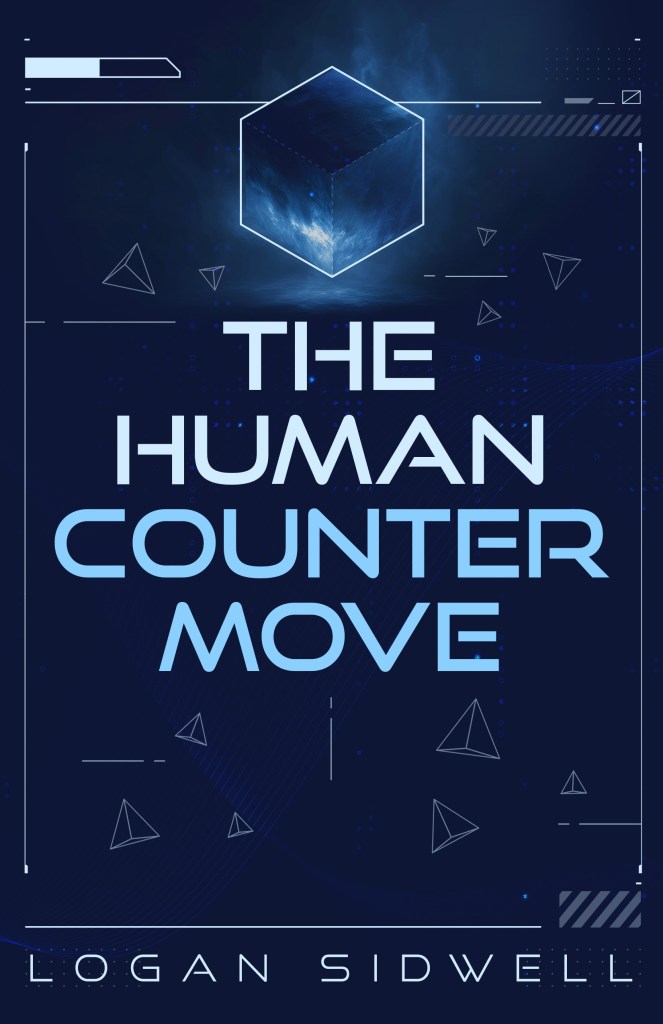
I wrote a book about a strategy game grandmaster challenging the AI Minds of his society for the fate of the future. It’s got politics, subterfuge, high-minded strategy, and danger. But I think at the heart of it all is a story about connection. A romance. Which is odd, because I don’t write romance.
Spoilers ahead.
A friend of mine pointed this out to me while they were reading my book. In the first chapter, you’re introduced to my main character, Zouk Solinsen, an isolated guy in the back half of his career navigating a cold and disconnected world. We’re then introduced to a young woman named Jamie. A rival in the strategy gaming space, and his opponent in the first round. They’re about the same age, opposite genders, and their conversation has a light, almost flirty back-and-forth before the game.
But it’s a red herring.
The target of this book’s romance isn’t Jamie. One of the romances isn’t even human.
Every good story has a certain element of romance. Whether it’s a pair of characters who hate each other and eventually learn to understand each other, or a collection of disjointed and quirky individuals finding the joy of becoming a cohesive group, what makes a romance is the journey from ambivalence and hatred to appreciation and love. Oftentimes, you don’t even need the kissy-kissy.
There are two ‘romances’ in The Human Countermove. The first is conventional. A small, personal story about Zouk and his wife Kira, whose relationship is on the rocks. Zouk is an outgoing person with a strong skill for communication, while Kira prefers her privacy. For her, a nice day is one spent in her office running data analytics and drinking hot cocoa.
In the time since they got married, life got complicated. Zouk had his career ups and downs, while Kira built quiet, steady work in the government. Zouk wants Kira to change, he wants her to love crowds and events and to be with him for all of it. She tries her best, but it’s not who she is.
But when he needs her, she’s there. Not usually with a well-placed word, but with her most sincere self. When Zouk is trying to make sense of a broken political system, she’s willing to put in weeks of work to help him. And she seems to relish every minute of it.
It’s all this that reminds Zouk why he fell in love with her. He remembers her passion, her care, the way she’s fought to stay in love with him. It’s a Him problem. He’s been asking her to change, when he’s the one that needs to start reaching out. He meets her where she is, accepts her for who she is, and is able to start loving again. They’re able to be that supportive, loving couple they had been chasing from the start.
But there’s a second romance in this story. One at a much larger scale.
A romance between Zouk Solinsen and The Minds.
Zouk is playing a series of strategy games in order to join The Minds’ council. Impossible games that take everything he has in order to win. But winning doesn’t suddenly put Zouk into power, it puts him in a partnership. A shared power structure with The Minds. And anyone forming a partnership knows the only way to make things in a partnership work is to ‘love’ the other party.
There’s an on-again, off-again relationship between Zouk and The Minds throughout the book. Near the beginning, The Mind of Communications and Influence is casual with Zouk. They’re fast friends and get along better than you’d think. The possibility of Zouk winning all the games becomes real. Folks listen when he speaks. The general consensus seems to be that he will be the fourth member of the council.
Then the hard times come. Zouk breaks ties to an organization when he discovers their plot to overthrow the government. And the break-up isn’t easy. A controversial game, a mutiny in the military, riots, and a frame job implicate Zouk in everything.
There’s nothing less romantic than a deposition. One of his wins is thrown out and The Mind of Strategy and Warfare ends his hopes of joining the council on a painful defeat. Whatever partnership The Minds were considering is dead.
If this were a traditional sci-fi dystopian story, this is the part where Zouk leads a resistance and burns it all down. But I wrote a romance. And in a romance, the protagonist doesn’t give up.
Zouk and Kira’s rekindled relationship is a lesson in accepting people as they are. A lesson that leads to a realization. The world talks to The Minds in the same way they talk to politicians. High-minded intellectualism, hopes and ideals, persuasion. But that’s not how The Minds think, that’s not who they are. They’re more like Kira. Evaluating good and bad ideas through raw numbers.
Society has been pushed to their limit. Every aspect is measured and maximized. But by seeing the world through The Minds’ eyes, Zouk and Kira uncover the fatal flaw, the mistake in the calculations, the first fix to a better world. Zouk knows his chance to join the council is dead. But he makes his case anyway. He makes it because he wants a better world, because he thinks The Minds help get them there.
And that act of good will and understanding changes everything.
This is why I say this book is a romance. It’s not traditional, but it hits all the beats. The meet-cute, the impossible relationship, the break-up, and at last the heartfelt reunion. A story whose roots are built in love and empathy rather than rage and destruction. I had no idea I was doing it when I wrote it, and only realized what I had made when it was out in the wild.
Maybe this is just what happens to stories that set out with a theme of connection and understanding. You go in planning on making a sci-fi thriller and end with an AI and a human holding hands in the rain.
The Human Countermove is available for purchase on Amazon!
 Author Logan Sidwell