First Contact Transcript, Species-215

First Contact, Species-215 (Colloquially known as The Scourge)

Notes have been added to provide expert context.

S-215 Transcript #1 (First Contact):

BEEP BEEP

BEEP BEEP BEEP

BEEP BEEP BEEP BEEP BEEP

*Fibonacci sequence continued until 13.*

Earth Station B, operator 6, Mark Simmons responds: 

Clear. Identify.

FRIEND*

*Message received in direct english

*Word in S-215 lexicon carries second meaning of TOOL

Hello friend. Location?

*S215 responds with coordinates of Ross 248, located approximately ten light-years from Earth.

You are Rumbigeals?

*Rumbigeals (S11) are the known residents of Ross 248 and were originally contacts twenty-three years prior to S215.

NOT RUMBIGEALS. FRIEND.

What is your species name?

*Pause in responses lasts thirty-one minutes.

MOURNERS. WE ARE THE MOURNERS. YOU ARE HUMANS.

Hello mourners, humanity welcomes you.

WE ARE GLEEFUL TO MEET YOU.

Your english is excellent. What is your business?

*First contact conversation ends here. Operator Mark Simmons noted the high lingual capacity of this alien species and speculated that they had analyzed humanity’s early interplanetary broadcasts.

S-11 Transcript #18,216 (Initiated approximately five hours later):

MS: Good meetings Rumbigeals, which operator am I speaking to?

Operator two of fifteen.

*Mark Simmons notes that fifteen is the total number of operators, not the number currently on shift. This is against protocol.

MS: Zorle! This is Mark. How are the new spawnlings?

Challenging but rewarding. Thank you for inquiring.

MS: Good, that’s how they’re supposed to be! Just a moment.

*It is here that Mark Simmons is joined by Earth Station B’s director. The two discuss Zorle’s unusually curt responses for nine minutes, forty-three seconds.

Mark? Are you there Mark?

MS: I’m here Zorle. Just wanted to check on you. Is everything okay?

I am good Mark. We are good.

MS: I’m glad.

Thank you for checking in. I have to go.

MS: Have you heard of a species called the mourners?

No.

MS: Okay. Thanks anyway.

*Six minutes pass

Wait. Yes. I know the mourners.

*Mark Simmons notes that all his messages from here on were subject to approval from the station director.

MS: What do you know about them?

Nomads. Travellers. Rovers. Wayfarers. Peaceful drifters. Not a problem.

MS: They sound like a nice group of people.

If you are lucky they will pass through your system and trade with your species.

MS: Yeah, I’ll cross my fingers. Be well, Zorle.

*Be well in Rumbigean is considered a permanent form of goodbye.

I wait for our next hello Mark.

*On completion of this conversation, Earth ceased communication to S-9. No messages were ever again received from the Rumbigeals.

S-215 Transcript #2:

*All messages to S-215 from this point forward were prepared, reviewed, and submitted from within Earth Station A’s situation room. Mark Simmons was brought in to type the messages and to retain communicative continuity.

Hello. Mourners are you there?

WE ARE HERE MARK. WE ARE CLOSER NOW.

Closer to Earth, you mean?

YES, WE ARE CLOSER. WE HAVE MUCH TO SHARE.

How much closer are you?

*Coordinates list unoccupied solar system Lalande 21185, approximately 8.31 lightyears from Earth.

*Chief of Security Lorne Richards types the next message.

How fast are you able to travel?

*No response after thirty minutes. The keyboard is returned to Mark Simmons.

Can you tell us anything about what you intend to share with us?

WE CANNOT RUIN THE SURPRISE.

Is it information?

IT IS A NEW WAY TO LIVE.

*Additional messages were forwarded to S-215, but no response was recieved.

Final notes:

Approximately 48 hours after this conversation, Earth’s governmental bodies approved an additional $12.9 trillion dollars in starship development and $4.5 trillion in weapons research. 9 additional species ceased all communication in the coming months. For further information, review documents on The Scourge, The Abandonment of Earth’s Southwestern Hemisphere, and Policies Regarding Encounters with Half-Dead.
The Amazing Digital Circus Mixes Marketing and Story

Sometimes I watch a little more Youtube than I should. My algorithm consists mostly of video essays on the economy, tournament footage, and random gaming clips. Well one day I was whiling the hours away watching a bit of nonsense, and the algorithm recommended the pilot to a new cartoon series. The Amazing Digital Circus. I did a cursory search and discovered this random pilot is the start of a mega-successful series with a massive fanbase, all based on an old sci-fi horror called I Have No Mouth and I Must Scream.

This week the finale was released and I binged the entire back half of the series in one night. It’s a fun and tense series for teens and young adults that was well worth the watch. But the thing that caught my eye was how Glitch Productions blurred the line between new episodes, new merch, and marketing.

Plot

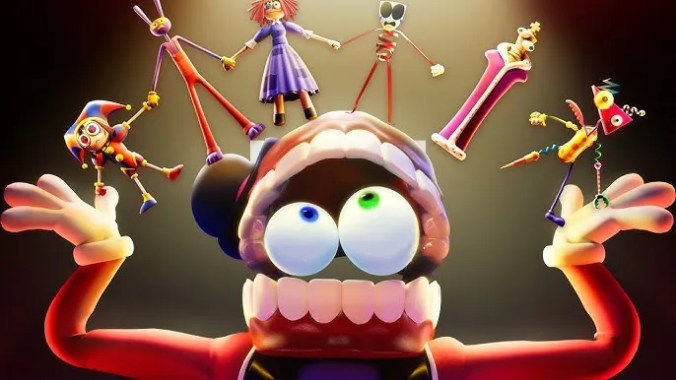
The Amazing Digital Circus tells the story of a group of unfortunates trapped inside an old 1990’s videogame. No one remembers their name, and everyone has taken on the form of an avatar appropriate for the circus atmosphere of the game. Kinger is a king chess piece, Jax is a prankster rabbit, and the protagonist Pomni is a sad little jester with very expressive eyes.

Running the world is an AI named Caine. Caine has godlike power in the simulation and a primary mission of keeping his trapped human guests engaged with his various adventures. If you’re familiar with the original Harlan Ellison story there may be some alarms going off in your head here. Thankfully instead of behaving like the malevolent AM of the original story, Caine brings an energy that’s a mix of circus barker and the Genie from Disney’s Aladdin (best captured during his show-stopping song in the eight episode).

Caine’s adventures inevitably go off the tracks in a dangerous and psychologically tormenting direction, and the plot of the show focuses on its human cast’s efforts to endure Caine’s accidental tortures while seeking a way out of their digital prison. It might sound like a horrific story, but the cartoony characters, comedic tone, and wacky settings take most of the edge off the physical horror, leaving only the existential.

An Exploration of Psychological Conditions

Since death is off the table, the worst-case scenario for our band of plucky characters is called ‘abstraction’. Years spent trapped in a simulation take their toll. If a character loses their grip on reality too much, they ‘abstract’, which means turning into a horrible monster that Caine makes sure to store permanently in the basement.

Keeping each other sane and healthy becomes the day-to-day focus of our characters. Each character has to fight their own inner-demons. To add insult to injury, the avatars in the game are specifically designed as physical representation of each person’s psychological struggles. Gangle carries a collection of masks and can only express the emotion on the mask she wears. Zooble’s body is an assortment of components she can mix and match, representing her own body dysmorphia. Ragatha is a raggedy ann doll that’s desperate for other’s approval. As the series goes on, we see each character’s deal with their own psychological turmoil. As you can imagine, there’s a heavy theme of self-acceptance that runs through the story.

Marketing Blurring Into Story

The entire series of The Amazing Digital Circus (TADS) was released directly to Youtube, rather than through some streaming service. From an accessibility standpoint, this allowed the show to reach a massive teen and young adult audience. From a financial standpoint, this meant Glitch Productions had to get creative.

If you’ve already seen every episode of TADS, you’ve actually only seen about 75% of the content related to the story. When a company advertises their upcoming episode, it’s a cut up of clips from the episode. Not here. Every preview TADS is entirely unique content. The AI Caine speaks directly to the audience, and often reveals elements of his character that weren’t visible inside the story.

One particularly meta moment comes when Caine advertises the series by practicing knife throwing on poor Pomni. Then in one of the later episodes, Pomni is blinked out of existence while eating a sandwich, and when she returns, she has a bunch of knives sticking into her jester avatar. The commercials are literally canon to the series.

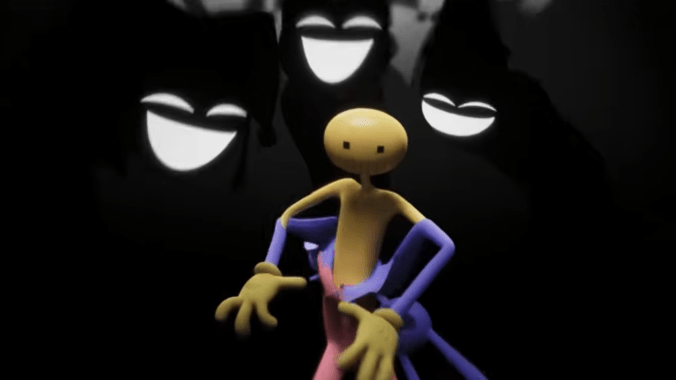
But it doesn’t just extend to previews. Merchandising is a key element of funding TADS, so one of Caine’s favorite gimmicks in the youtube shorts is to punish his players by taking their avatars and turning them into the plushies that are sold online and forcing them to sing songs or engage in various harrowing challenges. After watching the whole series, the best thing to do is go to Glitch Production’s Youtube channel and watch all the advertisements. They even hid some key lore related to one of the ‘abstracted’ characters that isn’t present in the main series while advertising pins and plushies.

Conclusion

The story is a great modernizing of a sci-fi classic with modern, psychological sensibility. But the greatest innovation of this series comes in the marketing. Glitch Productions didn’t just make a great story, it produced an online experience. The voice actors are regularly invited to play games with one another online, they’re brought out to cons, the fanbase is constantly speculating on tiny aspects of the lore, they even got the finale into theaters (with a sing-a-long of Caine’s song that you can see online).

We’re getting to a place in the modern age where tv advertising and big posters aren’t the way to get butts in seats. Rather than following the cinema model, Glitch Productions followed the model set by the game series Five Nights at Freddy’s. Make a ton of content, add enough deep lore to get the fanbase buzzing, and produce tiers of content. The end result is that no matter what kind of fan you are, you’ll always leave satiated.

The Monkey Wrench Gang Taps Into A Timeless Rage

My favorite books are the ones written from a totally unique perspective. For me, there is no greater joy than seeing the world through the eyes of someone I’ve never even met. What matters little to me matters lots to them. What I don’t see, they stared at their entire life. What I hate, they love.

The Monkey Wrench Gang by Edward Abbey is one of those books. It’s fifty years old, but its rage makes it feel like it was written yesterday. Edward Abbey is a self-described anarchist. A warrior against the industrial world. And the way he shares his views is downright infectious.

Eco Warriors in Southern Utah

The Monkey Wrench Gang tells the story of four people who don’t fit into society. Hayduke is a Vietnam veteran with a hatred for authority. Seldon Seen Smith is a polygamist whose hometown was drowned by the creation of Lake Powell. Doc Sarvis is a healer and a skilled billboard toppler. Lastly, Bonnie Abbzug is a dancer from the Bronx. When these four anti-establishment individuals discover their shared worldview, they set to work dismantling the machines and symbols of industry all over Southern Utah.

Sabotaging freeway constructions, shoving tractors off cliffs, even destroying a bridge or two are well within this group’s capability. Every act is described in thorough detail. The book follows the group as they move from job to job, each act of rebellion more ambitious than the last. We see the quiet moments as they probe each other’s philosophies, the loud moments when their work inevitably runs afoul of law enforcement, and the scary moments when life and death are in the balance.

The writing has a country edge to it. The dialog can swing blunt and vulgar, and some of the behaviors of the characters can be downright classless. But at the same time, it’s authentic. These aren’t perfect people, they have vices and flaws and pasts that torment them. When a helicopter comes flying over and Hayduke warns the team not to look up, it’s not because he studied helicopters in a book, it’s because he had to hide from them in the war.

There are so many stories these days about people with perfect lives and simple pasts. They use clean language and avoid offensive action. One mistake often defines who they are. We want to be able to sympathize with our characters. They need to appeal broadly.

These characters aren’t like that. They’re flawed, they’re often broken, and when they engage with the world, it’s with an edge sharpened by years of living outside of civilized society.

Rage and Anarchy

Edward Abbey’s vision of the world is seeped in rage. The characters aren’t mad at a single broken part of a mostly working system, but at a humanity that can’t seem to stop themselves. When Hayduke and Doc look out at a new bridge across the Utah Desert, they don’t see a great new way to travel, they see modern industry bulldozing over what used to belong to all of us.

And it’s not high-minded either. When Bonnie sees a bridge that brings more traffic to a certain canyon, she’s pissed her canyon is being taken away. When “Seldom Seen” Smith looks at Lake Powell, he sees the town he used to live in and the canyons and secrets he used to know buried by a new recreational fishing area.

The world they remembered was taken from them.

It’s my favorite aspect of this book. I’m pretty young, by the time I was born Utah was full-speed on industrialization. Two years ago, the view from my home was a big flat desert. Now it’s three layers of houses. My only memory of Utah is now. This book captures the state when it was untamed.

A lot of books today like to talk about anger. Characters go on big diatribes about ‘getting back what was taken’. In most cases, I find that talk empty. Not here. When Hayduke sees a tractor, gets out his car, and drives it into a ravine just to stall industrialization for a day or two, I feel that in my soul.

The Right Book A Half Century Later

Don’t read this book for a great ending, read it for the adventure, read it to see the world through an anarchist’s eyes, read it to feel a rage that’s not acceptable in polite society. We live in such a censored age, a lot of the words I want to use to describe this book and the actions taken in it have to be left out of the review.

I picked this book up because three of the most interesting people I had ever met all recommended it. Now I understand why. In a lot of ways, it feels like the perfect timing. Utah sits at the center of a new war against data centers. The rage I felt in Hayduke’s heart as he watched the government lay down miles and miles of freeway is the same rage that pulses in my own as I read about the new mega-structures they want to build in Box Elder. It’s the pain of seeing the world we grew up in ripped away and turned into something we don’t understand.

The Monkey Wrench Gang taps into emotions most books can’t reach. It’s fifty years old, but it feels like it was written yesterday.