It keeps happening. I’m making small-talk with a stranger. They ask what I do for work. I tell them I’m a novelist and the conversation drifts into books. I can already tell what’s coming, I can feel it. I don’t know how or why, but every conversation I have about books eventually goes the same way.
“Have you read Dungeon Crawler Carl?”
I’ve heard the same question from software engineers, road workers, scientists, and bartenders. We discuss the book for a few minutes, then I try to pivot the conversation. I ask them what else they’ve been reading. They always respond the same way, “Actually outside of this one, I haven’t read a book in years.”
The sales numbers can’t be argued. Dungeon Crawler Carl is the next big thing. But it’s more than that. This book is reaching a group of people who quit reading, or never started in the first place. Audiences written-off as non-readers are suddenly in play.
If you’ve been to a Barnes & Noble lately, then you know what I’m talking about. There are hundreds of genres in Barnes & Noble. It’s a competitive space. Even the mighty Science Fiction is tucked into a handful of shelves in a corner.
Dungeon Crawler Carl gets a bookshelf all to itself. The series is displayed front-and-center, only a few steps from the front doors.
The Plot
Dungeon Crawler Carl by Matt Dinneman tells the story of Carl, a coast-guard veteran from Seattle whose life is falling apart. On a cold and lonely night, an alien mining operation brings the world to an abrupt end, and every building on Earth is swallowed up by the ground.
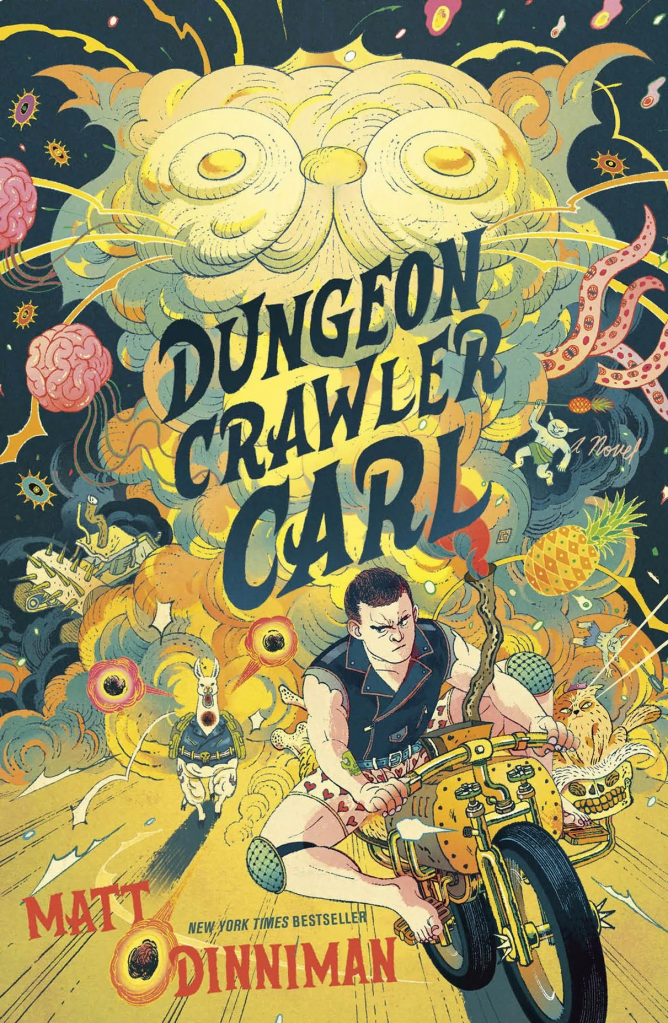
Carl is one of the few million survivors, as he was outside trying to catch his ex-girlfriend’s cat when the apocalypse arrived. An alien voice presents Carl and the rest of the survivors a way to save humanity: An 18-floor death game filled with monsters, traps, superpowers, and technology beyond imagination. The whole presentation feels like a game show. With no other options, Carl accepts the offer and enters the deadly game.
The first book in the series depicts a few early floors from the alien death game. It’s a strange place, where ultra-advanced technology meets nightmarish abominations. The world down in the dungeon behaves with videogame logic. Defeating monsters rewards loot and abilities. Boss monsters wait at the heart of each region.
Carl’s adventures are told with a light and comedic tone. Every monster and piece of gear is tagged with humorous flavor text that ensures the dark and deadly setting reads more fun than scary. The tone invites the reader to enjoy the ride, rather than worrying about realism and the constant life-or-death stakes.
Carl’s team helps to keep the tone light. That Persian showcat Carl saved at the start? She is granted the power of speech, along with a few magical spells. While Carl fights to survive, Princess Donut prioritizes elegance and aesthetics. This turns out to be an asset once the story weaves in audience participation and high-stakes talk-show interviews.
The Rise of The LitRPG
Dungeon Crawler Carl comes from a new sub-genre called LitRPG (Literary Role-Playing Game). It’s a relatively new expansion of the speculative fiction genre inspired by the mechanics of tabletop board games and videogames. In LitRPG’s, the explicit rules and coded behaviors of videogames are woven into the story in such a way that the character in the story is aware of those systems and intentionally makes decisions with them in mind.
When Carl defeats a goblin to earn a pair of magic boots, a text-box appears above the boots to explain exactly what kind of protection they offer and what magical effect wearing them will have. When Princess Donut casts Magic Missile, her mana supply is drained by 5 units. Bosses have health bars, pre-programmed characters have indicators above their head showing their allegiance, and there’s an admin in the background running balance patches on the game.
The genre of LitRPG is expanding rapidly, in no small part due to the success of Dungeon Crawler Carl. These are stories where the ambiguous behaviors of the real-world are removed and readers can mentally ‘play-along’ with the characters they read about. If you know Carl has a skill called ‘explosives expert’ and he finds a cart of explosives, it’s safe to assume the village of hostile goblins down the hall are in serious danger.
LitRPG is the return of the action-adventure genre for a new generation of readers. Not many modern readers have a lot of experience with war; so stories of guns, explosives, and sneaking into conflict zones no longer resonate. Instead, LitRPG’s draw on the tropes and expectations of the videogame and boardgame mediums. Defeating a boss awards treasure, gaining experience means levelling up, and performing extraordinary feats awards big achievements.
Growth of The Book Market
It’s hard to oversell the significance of Dungeon Crawler Carl on the modern reading scene. Because of this book, new readers with new sensibilities have flooded the market. This is particularly true of male readers, a group which has been reading less and less over the last two decades. The LitRPG genre appeals to a generation raised on videogames and online streaming.
This is a book that speaks to a crowd previous novels couldn’t reach. It’s silly, it’s fun, and it emphasizes comedic adventure over deep themes and heart-wrenching character arcs. It’s exactly the kind of fun new readers need.
I am thrilled Dungeon Crawler Carl exists in the marketplace. It is a joy to read and its existence is opening the door to a whole new genre of books for a brand new audience. Give it a few more years and I suspect there will be a new LitRPG shelf at Barnes & Noble.
Like my posts? Subscribe to my blog:

